Medicine begins with knowledge, but it cannot end there.
To practise medicine well, we must learn to observe carefully, reason responsibly and act humanely. We must know what the evidence says, recognise what it cannot tell us and understand how knowledge should be applied to the life of the person before us.
Medlock Holmes exists to cultivate clinical wisdom: the ability to see clearly, think deeply and care wisely.
CLINICAL WISDOM
The North Star
Knowledge informs. Reasoning interprets. Wisdom transforms.
Medicine is often taught as a collection of facts, mechanisms, diseases and treatments. Each is essential. Yet the possession of knowledge alone does not make someone a wise clinician.
Clinical wisdom is the ability to bring together:
- knowledge and observation;
- evidence and experience;
- reasoning and judgement;
- confidence and humility;
- values and responsibility;
- science and humanity;
- communication and compassion;
- action and reflection.
Knowledge asks:
What is true?
Reasoning asks:
What does it mean?
Wisdom asks:
What should we do—and how should we do it well?
The wise clinician does not merely arrive at the right answer. They understand how the answer was reached, where uncertainty remains, what matters to the person concerned and what responsibility follows from the decision.
Every part of Medlock Holmes points towards this destination.
THE MEDLOCK METHOD
See. Think. Care.
A way of practising medicine
See. Think. Care. is more than a motto. It is a clinical discipline.
It describes three movements of the mind and heart that should accompany every clinical encounter.
SEE
Observe carefully
See what is present.
Notice what is absent.
Listen not only to the words being spoken, but also to the hesitations, silences, patterns and changes surrounding them.
To see well is to remain curious long enough for the familiar to become visible again.
It means learning to:
- observe carefully;
- listen deeply;
- recognise patterns;
- notice contradictions;
- remain alert to context;
- distinguish signal from noise;
- see the person, not merely the symptom.
See without assumption.
THINK
Reason responsibly
Clinical reasoning is not simply the rapid recognition of a diagnosis.
It is the disciplined ability to connect knowledge, generate possibilities, test competing explanations and revise one’s thinking when the evidence changes.
It means learning to:
- connect information across disciplines;
- question first impressions;
- challenge assumptions;
- compare competing explanations;
- recognise bias;
- reason through uncertainty;
- know when the evidence is incomplete;
- change course when the facts demand it.
Think without arrogance.
CARE
Act humanely
A diagnosis is never merely a label. It may change how a person understands their body, their future, their family and themselves.
Care asks us to consider not only what can be done, but what should be done—and how it should be explained, shared and carried forward.
It means learning to:
- act compassionately;
- communicate clearly;
- preserve dignity;
- share decisions;
- respect values and context;
- balance benefit, burden and risk;
- accept responsibility;
- remember the life surrounding the illness.
Care without losing the person.
THE HUMAN EDGE
Medicine in the Age of AI
Using intelligence wisely
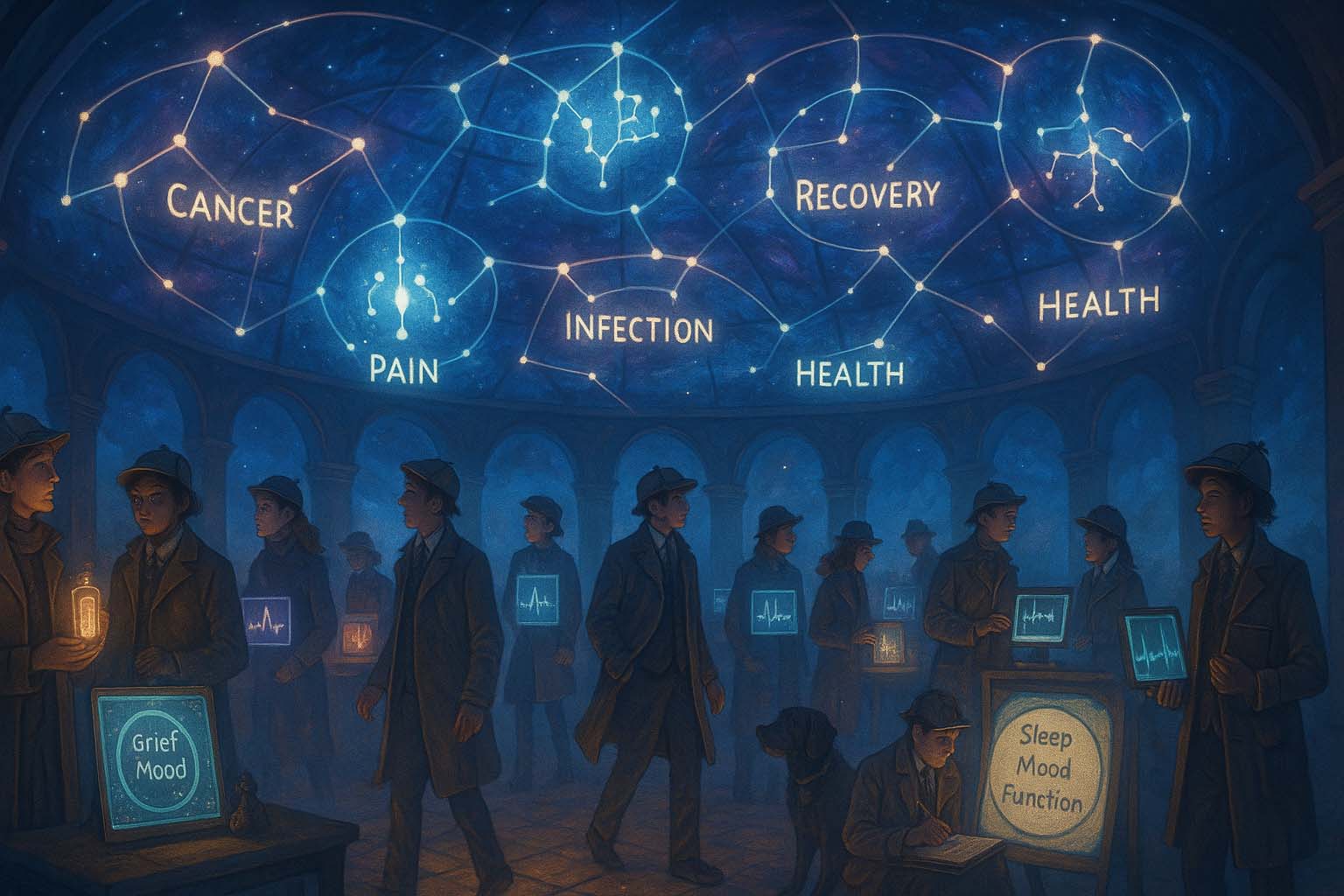
Healthcare is entering an age of extraordinary intelligence.
Artificial intelligence can increasingly retrieve knowledge, summarise evidence, recognise patterns, interpret data, generate differential diagnoses and support decision-making.
These capabilities will transform medicine.
But they do not remove the need for clinical wisdom.
They increase it.
Information may become easier to obtain, yet someone must still decide:
- whether the information fits this person;
- what may have been overlooked;
- what evidence can be trusted;
- where bias may be operating;
- what matters most;
- whose values should guide the decision;
- when uncertainty must be acknowledged;
- how benefits and harms should be balanced;
- how difficult information should be communicated;
- who will accept responsibility for the consequences.
The future clinician will not be distinguished simply by having access to more information.
They will be distinguished by knowing how to use information wisely.
AI may widen the field of vision. Wisdom determines where to look, what to trust and how to act.
Medlock Holmes does not position technology as the enemy of humanity. Nor does it treat technology as a substitute for judgement.
The task is to bring human and artificial intelligence together without surrendering curiosity, responsibility or care.
The human edge is not the ability to memorise more than a machine.
It is the capacity to understand meaning, recognise suffering, negotiate values, accept responsibility and remain present when no answer is perfect.
VALUES IN CARE
The Values Compass
What guides us when the map is incomplete
Medicine is filled with moments in which knowledge alone cannot determine the right course.
Two treatments may be clinically reasonable. Evidence may be uncertain. Benefits may come with significant burdens. The priorities of the clinician, patient, family and healthcare system may not be the same.
In these moments, values are not decorative words displayed on a wall.
They are instruments of navigation.
Values in Care is a Medlock Holmes sequence exploring one hundred values and the part each can play in healthcare.
Each value will ask a practical question:
What does this value look like when it is lived in clinical care?
The series will examine how values shape:
- the way we see patients;
- the questions we ask;
- the judgements we make;
- the relationships we build;
- the risks we accept;
- the language we use;
- the systems we design;
- the kind of clinicians we become.
ONE HUNDRED VALUES
One hundred lenses through which to examine care
The collection will include values concerned with seeing the person, thinking responsibly, working together and acting with care.
Seeing the person
Dignity. Empathy. Compassion. Respect. Curiosity. Attentiveness. Patience. Presence. Kindness. Hope.
These values ask us to look beyond disease and encounter the person living through it.
Thinking responsibly
Integrity. Honesty. Humility. Courage. Wisdom. Accountability. Prudence. Fairness. Openness. Discernment.
These values guide us when evidence is incomplete, choices are difficult and certainty is tempting.
Working together
Partnership. Trust. Inclusion. Communication. Collaboration. Reciprocity. Loyalty. Generosity. Belonging. Solidarity.
These values remind us that healthcare is created through relationships, not delivered through expertise alone.
Acting with care
Safety. Reliability. Service. Stewardship. Justice. Advocacy. Continuity. Responsiveness. Responsibility. Excellence.
These values translate intention into behaviour, systems and action.
No value exists in isolation.
Compassion without wisdom may lead us towards unhelpful action. Courage without humility may become recklessness. Efficiency without dignity may make a service faster but less humane. Loyalty without honesty may prevent necessary challenge.
Clinical wisdom lies partly in knowing which values are speaking, where they are in tension and how they might be held together.
VALUES BECOME VISIBLE THROUGH ACTION
Every value in the series will be explored through medicine and healthcare.
Not merely:
What does courage mean?
But:
What does courage look like when a junior doctor must challenge a senior decision?
Not merely:
What is dignity?
But:
How is dignity protected when a person is frightened, confused, dependent or unable to speak for themselves?
Not merely:
Why does honesty matter?
But:
How should uncertainty, error and difficult news be communicated?
Values become meaningful when they move from aspiration to action.
Explore the 100 Values in Care.
THE MEDLOCK ECOSYSTEM
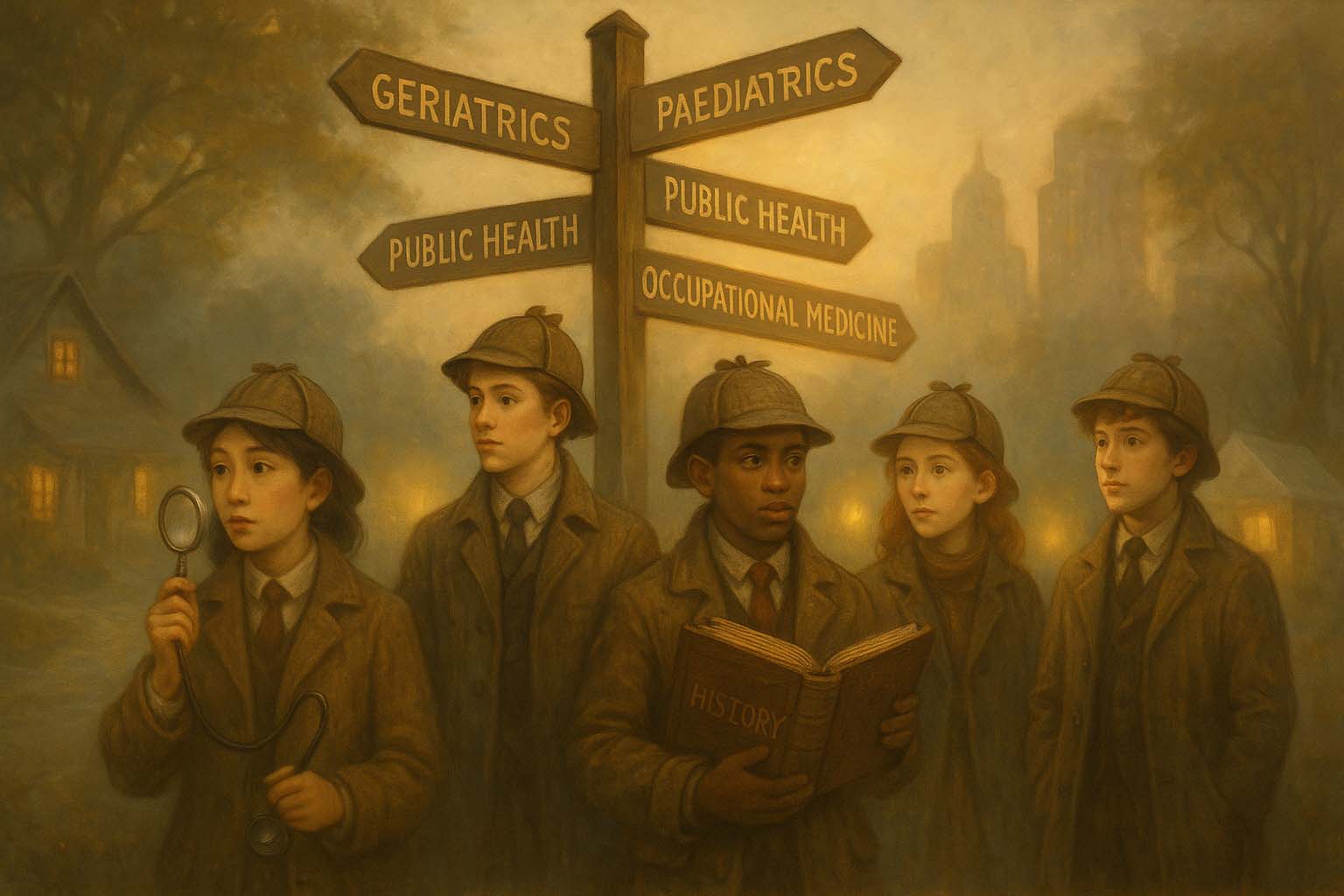
Different Doors. One Destination.
Medlock Holmes offers many ways of entering medicine.
Some begin with curiosity. Some begin with science. Some begin with a patient’s story. Some begin with a question, an image, a sound or a mystery.
Each door is different.
The destination is the same: deeper understanding, stronger reasoning and wiser care.
SPARK
Curiosity. Purpose. Calling.
Discover medicine before deciding whether it is the life you wish to enter.
Spark invites young people and curious learners to explore the body, the work of healthcare and the questions that lie beneath a medical calling.
Spark awakens curiosity.
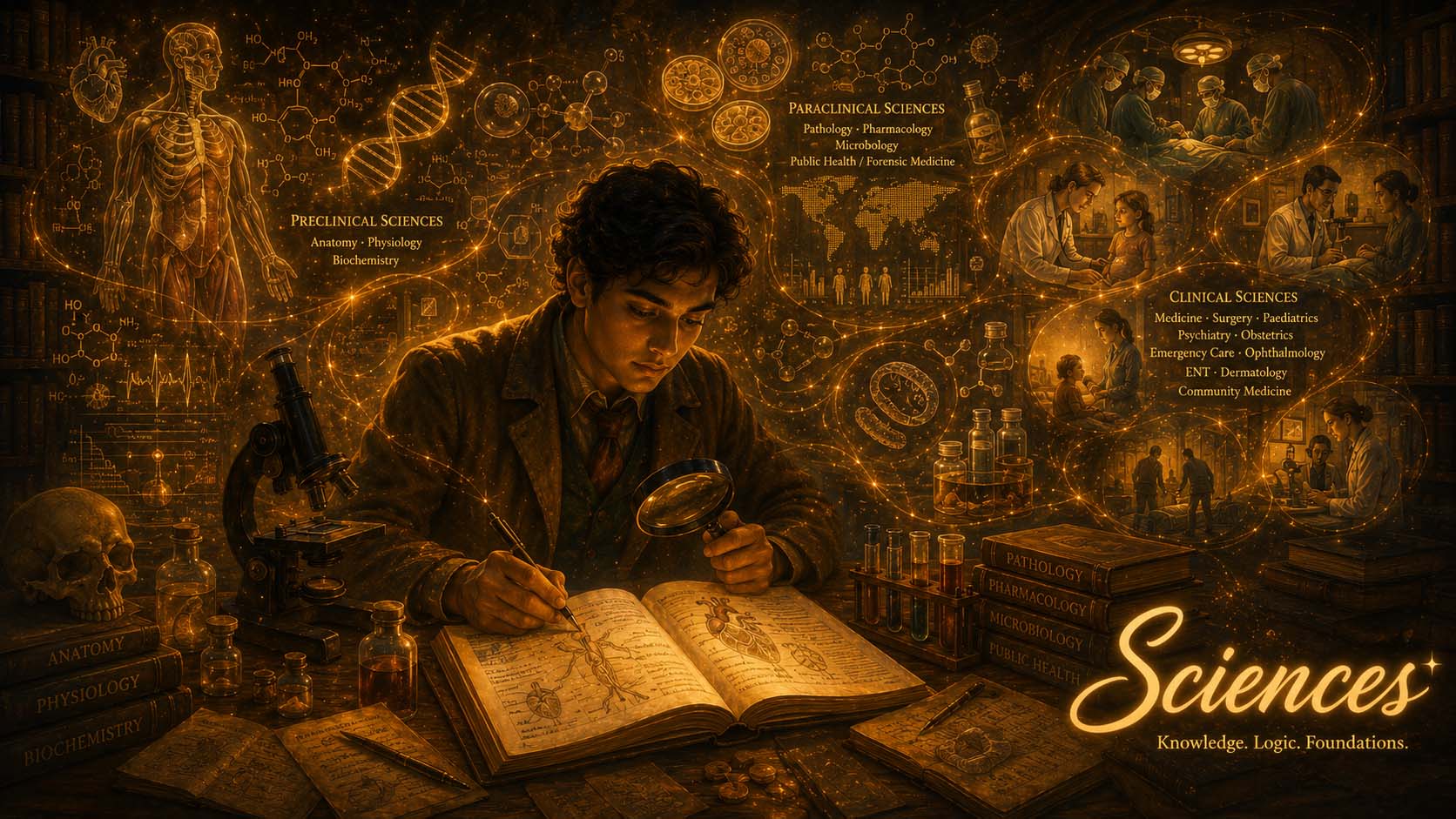
SCIENCES
Knowledge. Logic. Foundations.
Learn the structures, mechanisms and principles upon which medicine is built.
Sciences provides the language through which the body, disease and treatment can be understood.
Sciences build knowledge.
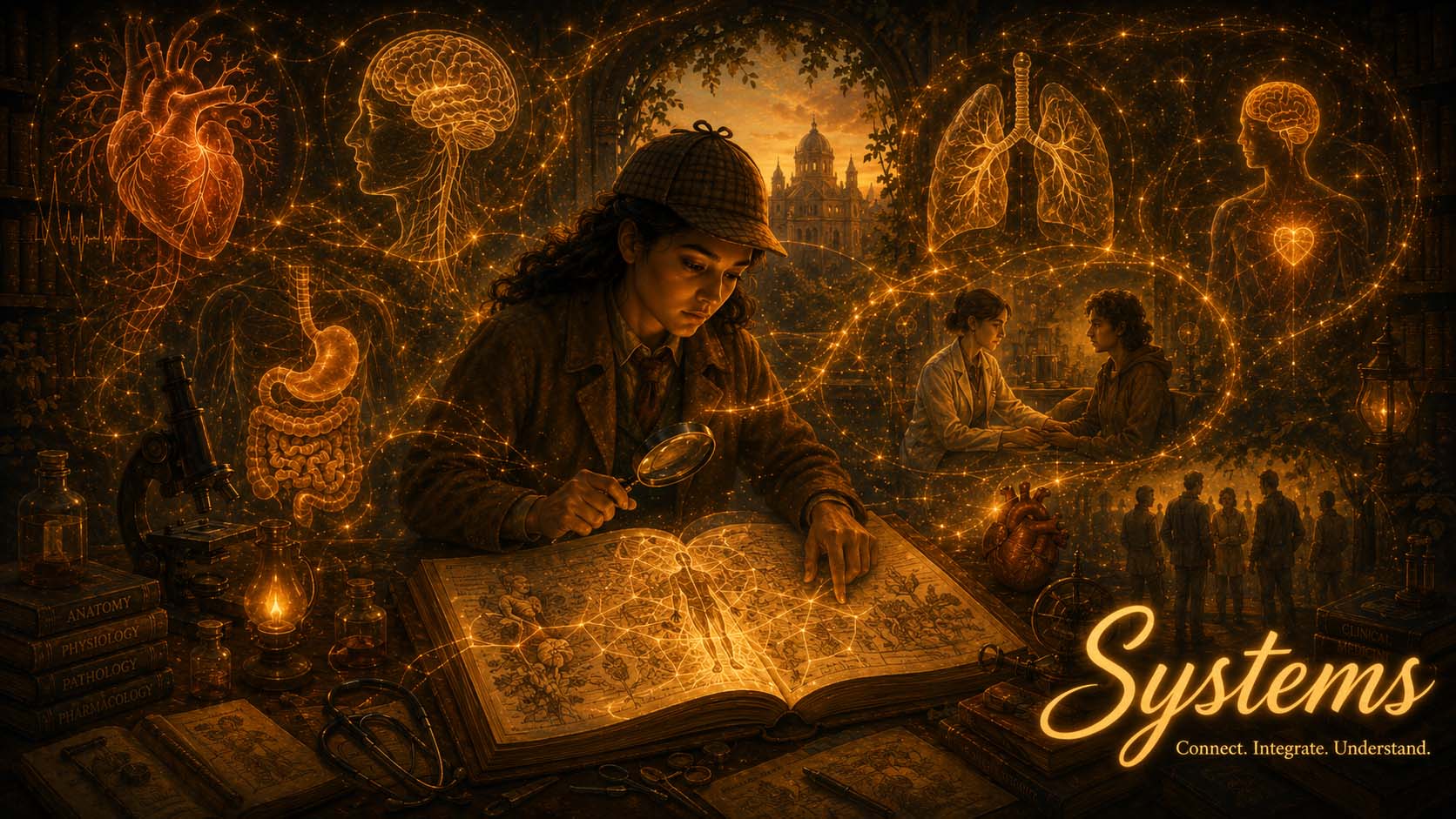
SYSTEMS
Connect. Integrate. Understand.
The human body does not live in separate academic departments.
Systems brings anatomy, physiology, pathology, pharmacology and clinical medicine together around the functioning person.
Systems create understanding.
STORIES
Detect. Deduce. Diagnose.
Patients rarely arrive carrying the name of their diagnosis.
They arrive with pain, weakness, breathlessness, fear, fever, bleeding, confusion or change.
Stories begins where clinical medicine begins: with the person’s presentation.
Stories develop reasoning.
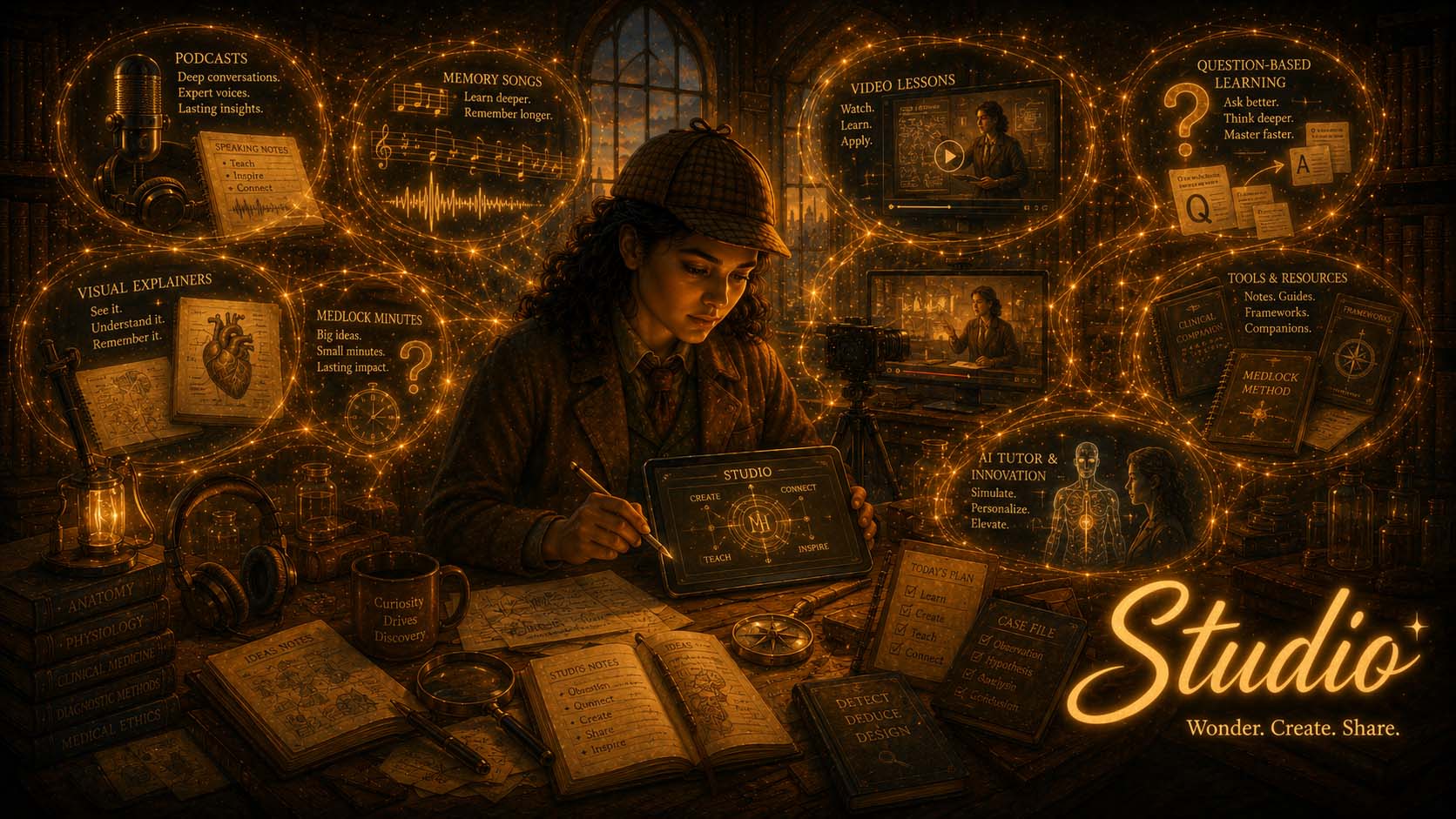
STUDIO
Wonder. Create. Share.
Learning can happen through explanation, conversation, image, music, reflection, challenge and play.
Studio explores different ways of making medical ideas memorable, accessible and alive.
Studio keeps learning alive.
SPIRIT
See. Think. Care.
Spirit asks why the knowledge matters, what should guide its use and what kind of clinician the learner is becoming.
Spirit turns knowledge, understanding and reasoning towards wisdom.
OUR STORY
Why Medlock Holmes Exists
The story behind the detective
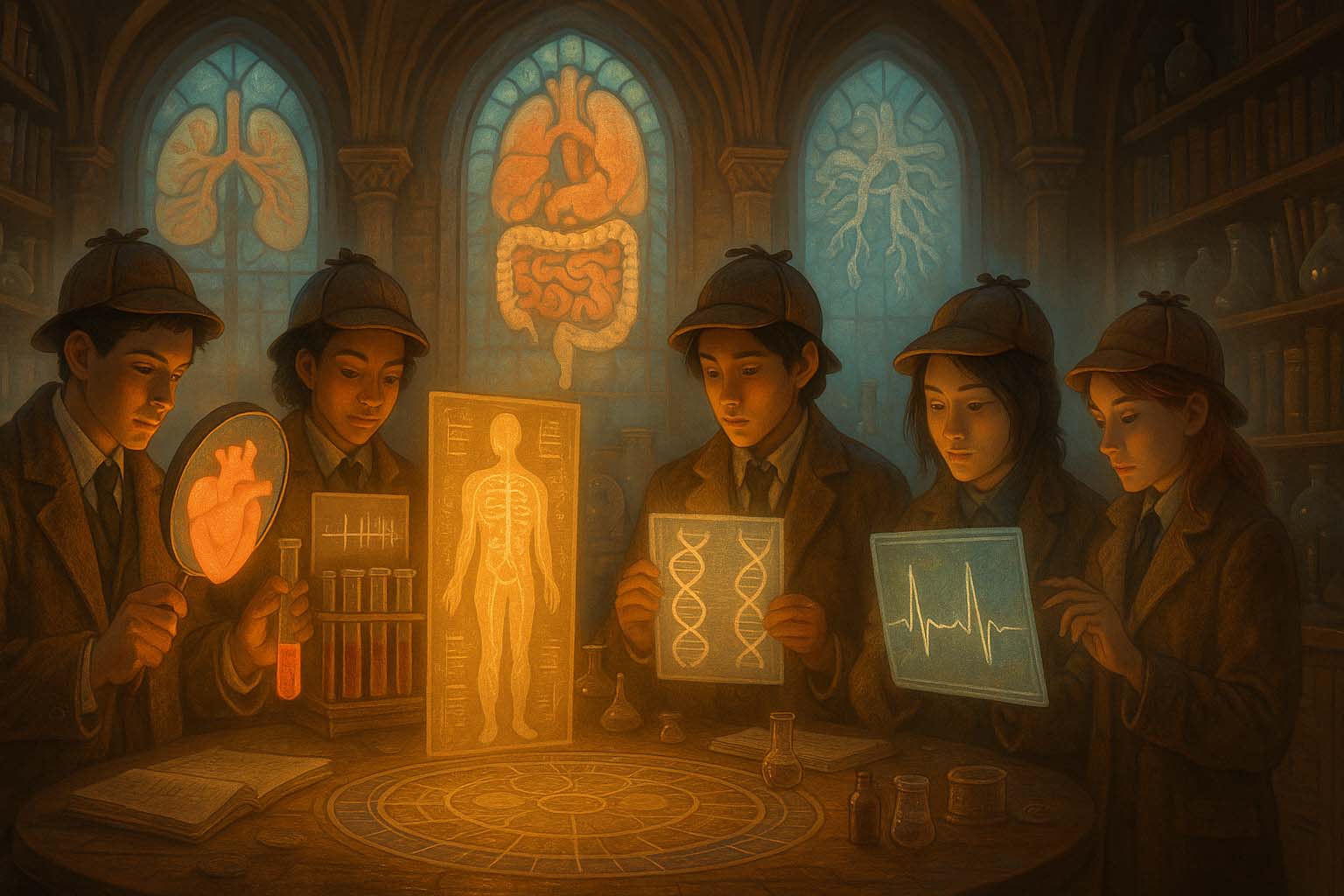
The physician and the detective share a particular way of looking at the world.
Both begin with incomplete information.
Both gather testimony, inspect evidence, notice inconsistencies, distinguish signal from noise and test competing explanations.
Both must remain alert to bias.
Both must be willing to revise their beliefs when new evidence appears.
Both must act under uncertainty.
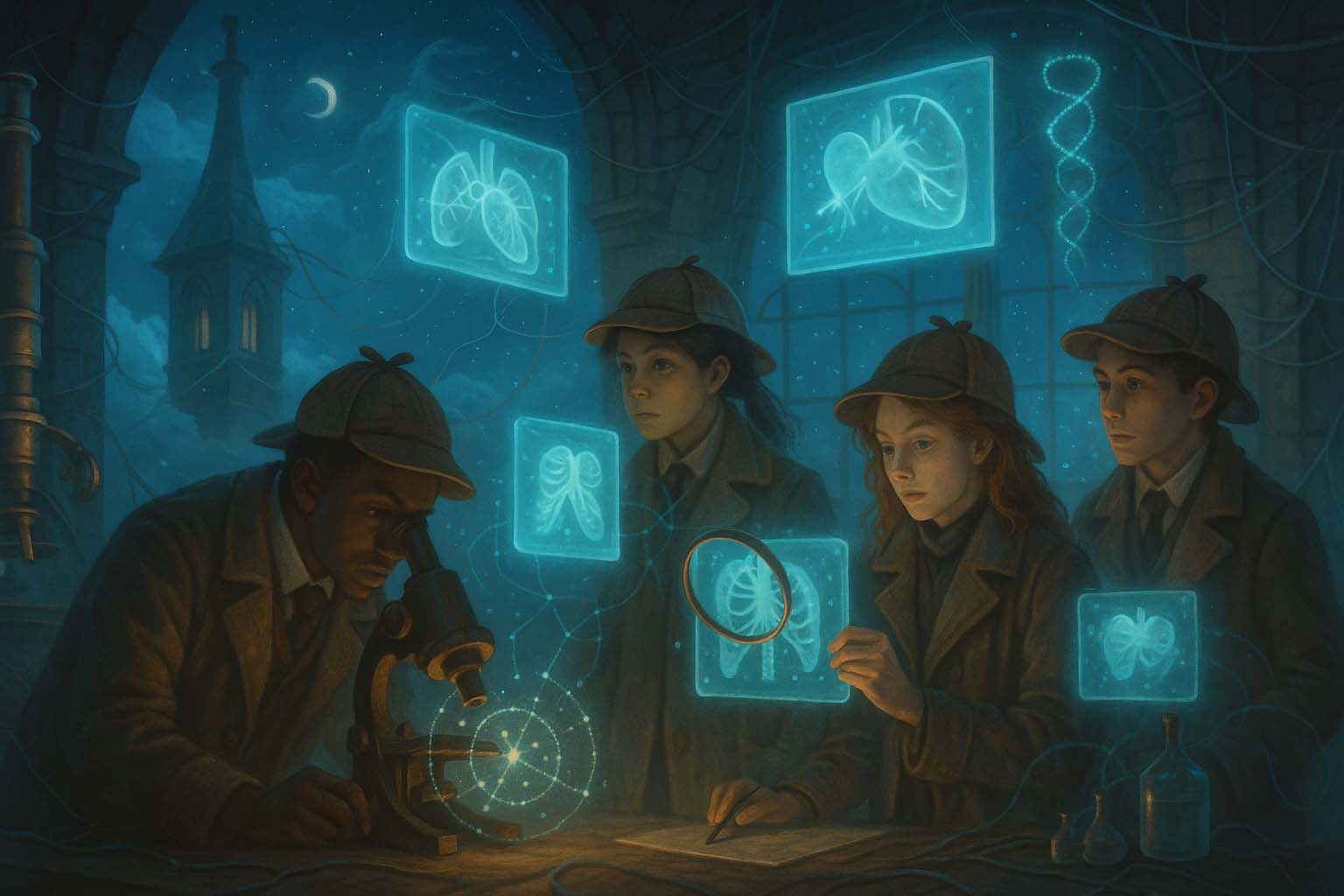
This is the world of Medlock Holmes: where the art of detection meets the science of deduction and becomes the skill of diagnosis.
But there is one crucial difference.
The detective solves a mystery. The clinician must also care for the person who has lived through it.
Medlock Holmes was created because medicine deserves to be taught as more than an accumulation of facts.
It should inspire curiosity.
It should make complex ideas understandable without making them simplistic.
It should help learners connect knowledge that is too often divided into separate subjects.
It should reveal the hidden processes behind clinical reasoning.
It should make room for uncertainty, values, imagination and reflection.
Above all, it should never allow the fascination of the mystery to eclipse the humanity of the person.
Medlock Holmes brings together medicine, education, storytelling, art, technology and clinical experience.
Its roots are international and cross-cultural because medicine itself crosses countries, traditions, languages and lives.
Its purpose is not merely to help people know more.
It is to help them notice more, question more carefully and care more wisely.
THE DIFFERENCE IT MAKES
What You Carry Forward
The value of education lies not only in what is remembered, but in how it changes the learner.
For the curious learner
Medlock Holmes helps you:
- explore whether medicine genuinely interests you;
- understand what a life in healthcare may involve;
- replace borrowed ambition with informed choice;
- become more confident asking questions;
- discover the many different lives within medicine;
- develop a language for curiosity and reflection.
For the medical student
Medlock Holmes helps you:
- connect fragmented knowledge;
- understand mechanisms rather than memorise isolated facts;
- reason through clinical presentations;
- strengthen pattern recognition;
- revisit difficult concepts through multiple formats;
- prepare for examinations without losing the purpose behind the learning.
For clinicians
Medlock Holmes offers a place to:
- revisit clinical foundations;
- reflect on judgement and uncertainty;
- examine values in practice;
- strengthen teaching;
- support continuing professional development;
- remain intellectually and morally curious.
For families
Medlock Holmes can help families:
- support exploration without creating pressure;
- understand what medicine asks of a person;
- encourage thoughtful career discernment;
- recognise different pathways into healthcare;
- accept that another professional life may sometimes be the wiser destination.
For schools and educators
Medlock Holmes can help educators:
- offer structured, longitudinal exploration of medicine;
- create authentic opportunities for reflection;
- make the hidden curriculum more visible;
- support learners without medical family connections;
- connect scientific learning with professional identity and values.
The ambition is not to manufacture identical clinicians.
It is to cultivate thoughtful people who can bring knowledge, judgement and humanity to whatever role they eventually choose.
OUR COMMITMENTS
The Standards We Hold Ourselves To
Wisdom requires responsibility
Spirit is not simply a collection of ideals.
It shapes how Medlock Holmes creates, teaches and behaves.
Clinical integrity
Content should be evidence-informed, appropriately reviewed and clear about the limits of what is known.
Human dignity
Patients should never be reduced to diagnoses, specimens, stereotypes or entertaining puzzles.
Every clinical story belongs first to a human life.
Responsible AI
Artificial intelligence should be used transparently, thoughtfully and under meaningful human supervision.
It should support education and judgement, not impersonate certainty or replace professional responsibility.
Inclusion
Medicine should reflect the diversity of the people it serves.
Our work should represent different cultures, genders, ages, abilities, identities, places and professional backgrounds with care and authenticity.
Accessibility
There should be more than one doorway into understanding.
Learners should be able to encounter ideas through text, sound, image, story, explanation, reflection and practice.
Intellectual humility
We will seek to distinguish clearly between:
- established knowledge;
- reasonable interpretation;
- emerging evidence;
- genuine controversy;
- unresolved uncertainty.
Not knowing is not a failure when uncertainty is recognised honestly and approached responsibly.
Safety
Educational material must never pretend to replace qualified clinical care, professional supervision or appropriate local guidance.
Reflection over performance
Education should help people become wiser, not merely appear cleverer.
The purpose is not to reward certainty, speed or display.
It is to cultivate attention, understanding, judgement and growth.
Curiosity with responsibility
Questions should be encouraged, assumptions examined and conventional thinking challenged.
But curiosity must always remain connected to evidence, ethics and the welfare of others.
JOIN THE JOURNEY
An Invitation
Medicine needs knowledge.
But knowledge is only the beginning.
It needs people who notice what others miss.
People who listen before concluding.
Who question without becoming cynical.
Who reason without becoming detached.
Who can hold confidence and humility together.
Who use technology without surrendering judgement.
Who understand that uncertainty is not an excuse for inaction, nor certainty a licence for arrogance.
Who remember that behind every symptom is a person living a life.
Medlock Holmes is an invitation to cultivate that way of seeing.
Come and learn to:
See more carefully.
Think more deeply.
Care more wisely.
Medlock Holmes
The Art of Detection.
The Science of Deduction.
The Skill of Diagnosis.