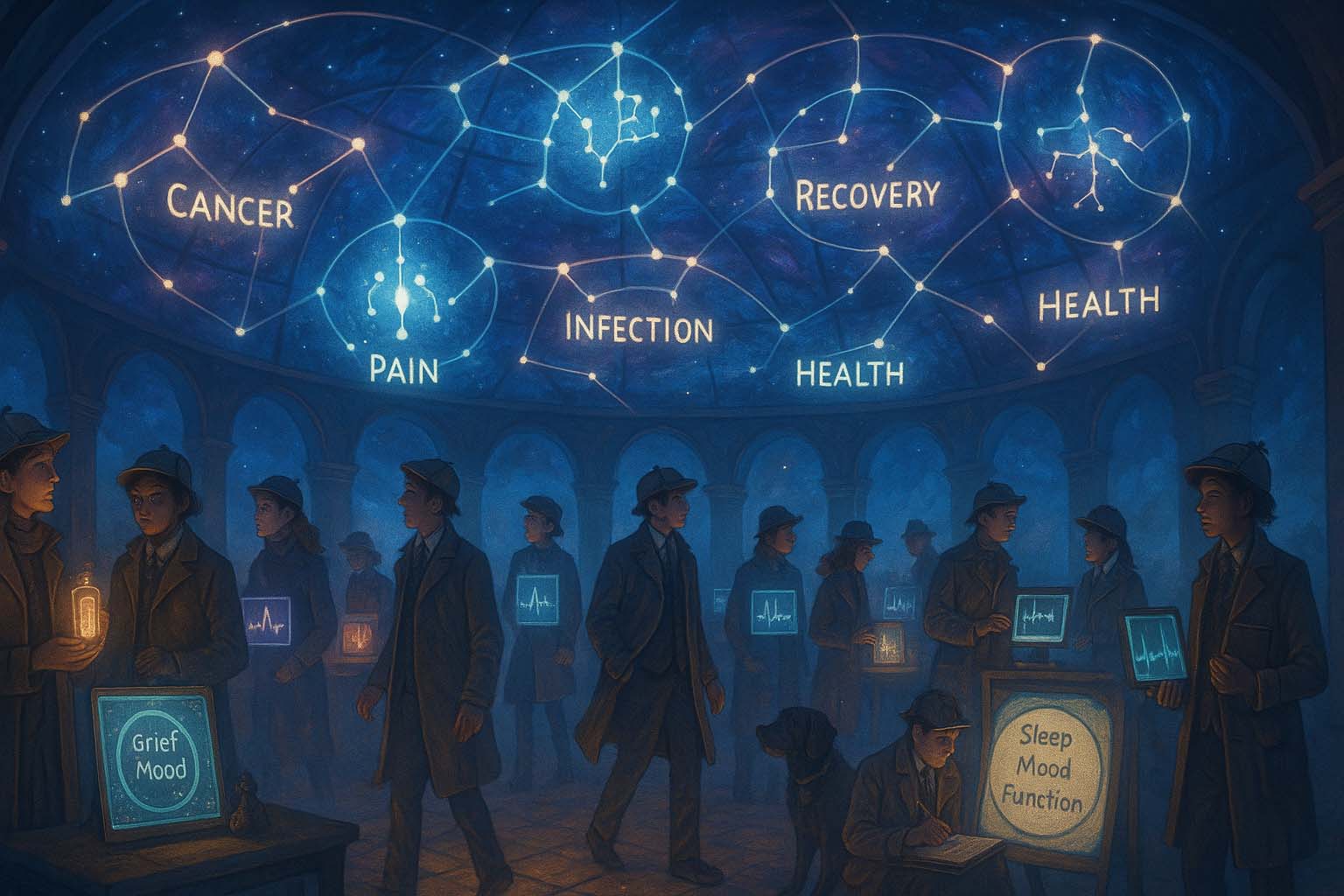
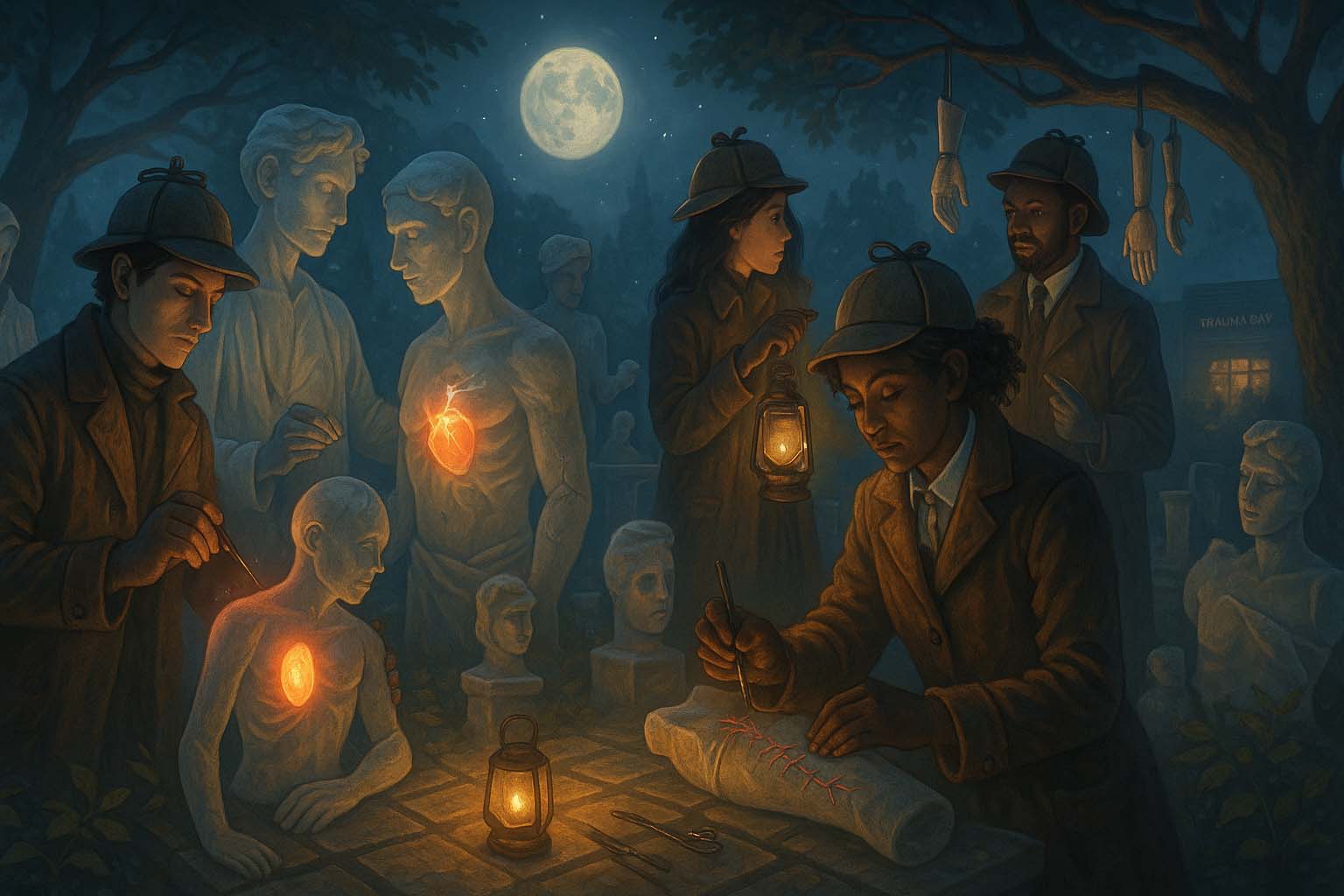
A splinter pierces the skin.
A virus enters through the nose.
A blood vessel tears.
Cells are injured.
Within moments, invisible systems begin to respond.
Blood begins to clot. Immune cells move towards danger. Chemical messages spread. Temperature may rise. Damaged tissue is cleared away and rebuilding begins.
You do not have to instruct any of this to happen.
How does the body know what to fight, what to protect and what to repair?
Enter the World
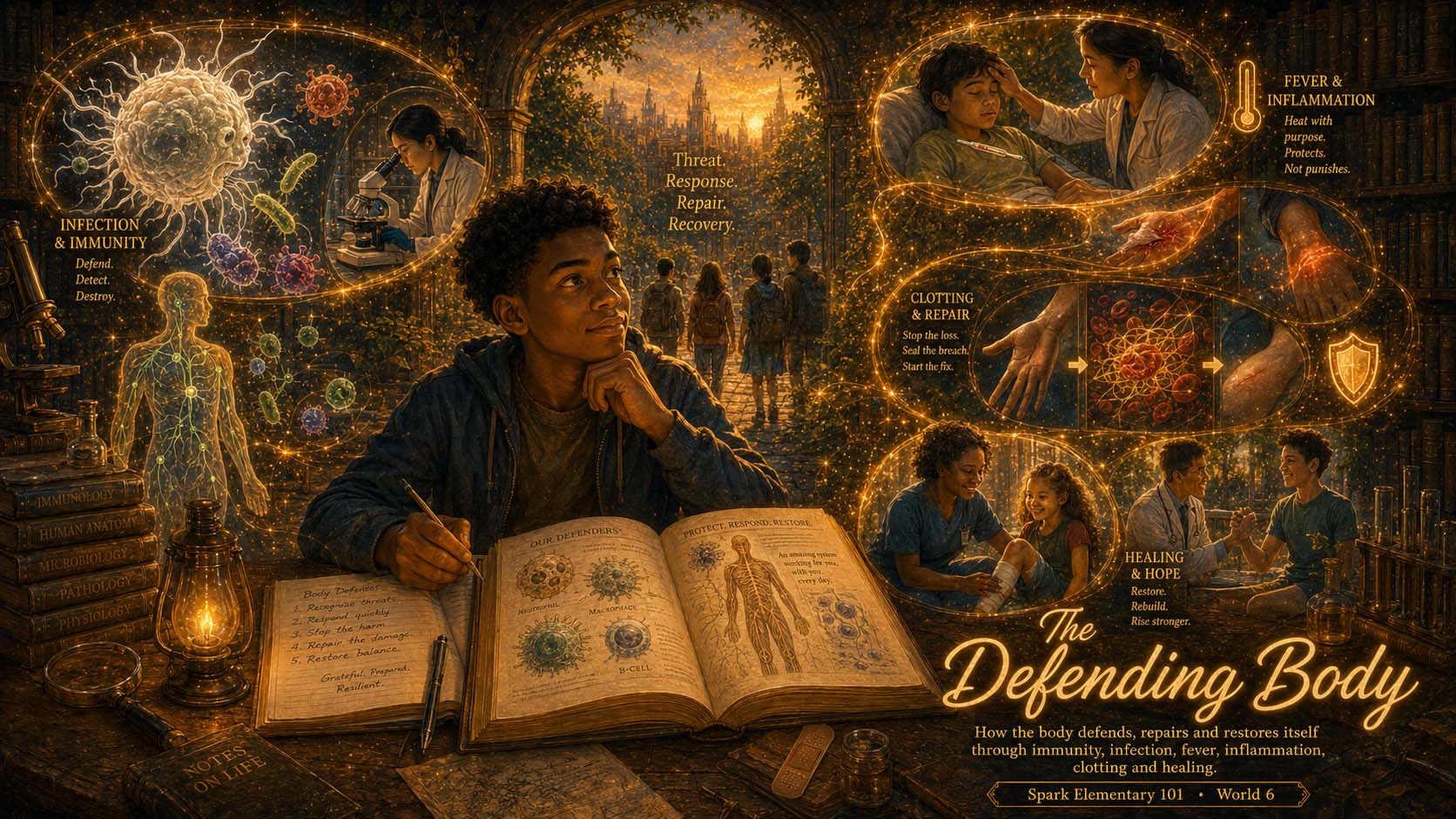
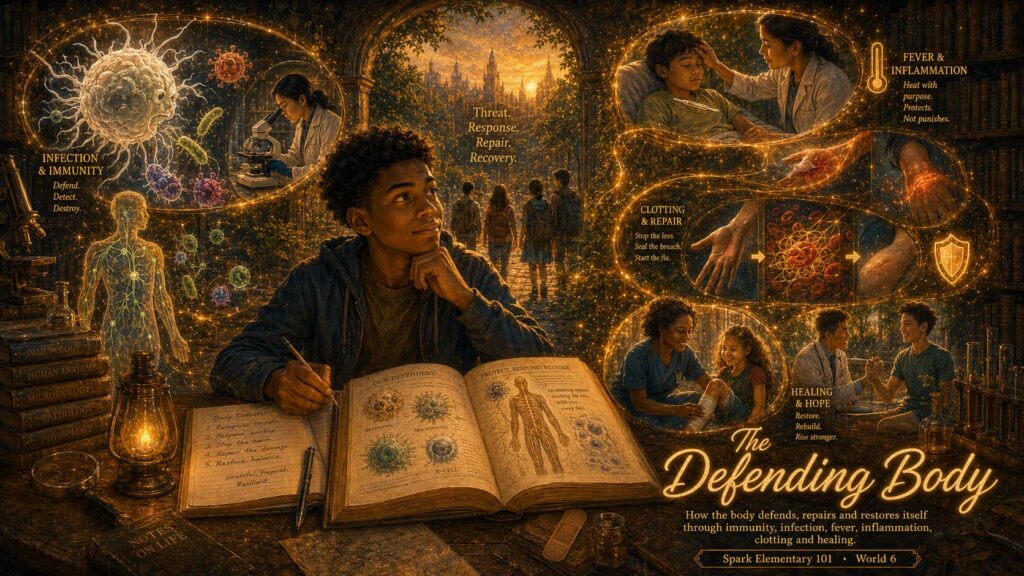
The Defending Body explores the systems that protect us from infection and help us survive injury.
You will begin at the moment a microorganism crosses one of the body’s boundaries.
You will discover how the immune system recognises danger, how it remembers previous encounters and how vaccination prepares it before a serious infection arrives.
You will also investigate what happens when defence loses its accuracy and begins attacking the body itself.
Then you will follow the body’s alarm signals through fever and inflammation.
Finally, you will watch blood seal a broken vessel and tissue rebuild beneath a wound—sometimes restoring the original structure, and sometimes leaving a scar.
This is not simply a World about destroying germs.
It is about recognition, restraint, sacrifice and repair.
Three Paths Through the Defending Body
Infection and Immunity
The body is not separate from the microbial world.
Bacteria, viruses, fungi and other microorganisms surround us. Many also live harmlessly on the skin and inside the body.
Why do some encounters cause no difficulty while others lead to illness?
How does the immune system recognise an invader among trillions of the body’s own cells?
And how can it remember a threat it encountered years ago?
Fever and Inflammation
Fever, redness, heat, pain and swelling often feel like signs that something has gone wrong.
Yet many of them are created deliberately by the body.
Why would the body raise its own temperature?
Why does injured tissue become hot and swollen?
And when does a helpful response become damaging?
Clotting and Healing
A damaged blood vessel creates an immediate problem.
Blood must remain fluid while travelling through healthy vessels—but become solid enough to seal a wound within seconds.
Once the bleeding stops, slower work begins.
Cells clear debris, build new blood vessels, produce collagen and restore the broken barrier.
How does the body know when to clot?
How does a wound rebuild itself?
And why does survival sometimes leave a scar?
Ten Questions to Follow
ELM-051
Why do we get infections?
Why do some microorganisms live alongside us harmlessly while others enter tissues, multiply and cause disease?
ELM-052
How does the body recognise an invader?
How can the immune system distinguish dangerous microbes and damaged cells from the tissues it must protect?
ELM-053
Why do vaccines work?
How can a safe encounter today prepare the immune system to respond more quickly months or years later?
ELM-054
Why can the immune system attack the body itself?
What happens when a defence system mistakes part of the body for an enemy?
ELM-055
Why do we get a fever?
Why does the body deliberately raise its temperature—and why do we shiver while becoming hotter?
ELM-056
Why does inflammation exist?
Why would the body create pain, swelling and reduced movement in response to injury or infection?
ELM-057
Why do wounds become red, hot and swollen?
Are these changes signs of normal healing, infection—or sometimes both?
ELM-058
Why does blood clot?
How does blood remain fluid inside healthy vessels yet rapidly form a seal when a vessel is damaged?
ELM-059
How does a wound heal?
What is happening beneath a scab as the body contains, clears, rebuilds and remodels damaged tissue?
ELM-060
Why do scars form?
Why can the body restore strength after an injury without recreating the original tissue perfectly?
The Body Has Boundaries
Protection begins before the immune system attacks anything.
The skin forms a physical wall.
Mucus traps particles.
Cilia move material from the airways.
Tears and saliva contain defensive substances.
Stomach acid destroys many swallowed organisms.
Coughing, sneezing and urine flow help remove threats.
Communities of harmless microorganisms also compete with those that might cause disease.
These boundaries are not impenetrable walls.
They are living borders—continually allowing useful exchange while resisting danger.
When a microorganism crosses one of them, the body must decide:
Is this harmless?
Is this unfamiliar?
Is tissue being damaged?
How strong should the response be?
Recognition Comes Before Attack
The immune system cannot simply destroy everything that appears unfamiliar.
The body contains trillions of its own cells.
It also lives alongside food molecules, harmless microbes and substances from the environment.
Defence therefore depends upon recognition and context.
Some immune responses act rapidly, recognising broad signs of microbes or damage.
Others develop more slowly and target highly specific molecules.
These targeted responses can create memory, allowing the body to respond faster during a later encounter.
But recognition is not perfect.
The immune system may:
miss a dangerous infection
respond too weakly
overreact to something harmless
reject transplanted tissue
or attack part of the body itself
The Defending Body reveals that survival depends not only upon the strength of defence.
It depends upon its accuracy.
Vaccination Is a Rehearsal
A vaccine allows the immune system to encounter a safe version, component or instruction associated with a microorganism.
The immune system responds by creating specialised cells and, in many cases, lasting memory.
If the real infection later arrives, the response can begin sooner and with greater precision.
Vaccination is therefore not simply a shield placed around the body.
It is a rehearsal before the dangerous performance begins.
Its protection also extends beyond the individual.
When enough people possess immunity, an infection may find it harder to travel through a community. This helps protect people who are too young, too unwell or unable to respond fully to vaccination themselves.
Defence can therefore be both biological and collective.
Protecting ourselves may also help protect someone we have never met.
Protection Has a Cost
Inflammation helps the body contain danger and begin repair.
Blood vessels widen.
More blood reaches the area.
Vessel walls allow fluid, proteins and immune cells to enter the tissue.
Damaged material is removed.
Signals summon further help.
These changes explain the familiar features of inflammation:
Redness and heat arise from increased blood flow.
Swelling develops as fluid enters the tissue.
Pain results from sensitised nerves, chemical signals and pressure.
Reduced function encourages the injured area to rest and protects it from further damage.
For a short time, these changes may be helpful.
But inflammation that is excessive, prolonged or misdirected can damage the very tissues it was meant to protect.
The body faces a constant dilemma:
How much defence is enough?
Too little response allows danger to spread.
Too much response harms healthy tissue.
The wrong response attacks the wrong target.
Fever Is a Change of Target
During fever, the body is not simply becoming hot by accident.
Immune signals influence the hypothalamus—the part of the brain involved in regulating temperature—and temporarily raise the body’s target temperature.
The existing temperature then feels too cold.
Blood vessels in the skin narrow.
The person seeks warmth.
Muscles shiver to produce heat.
Later, when the target returns towards normal, the person feels hot and begins sweating.
Fever may support parts of the immune response, but it also increases the body’s demands and can make someone feel exhausted.
A temperature reading therefore matters—but it never tells the whole story.
One child with a fever may be alert and drinking.
Another with the same temperature may be difficult to wake or struggling to breathe.
Medicine does not treat the thermometer alone.
It assesses the person carrying the fever.
A Clot Is a Temporary Rescue
Blood faces an extraordinary challenge.
It must flow freely through thousands of kilometres of vessels without solidifying.
Yet when a vessel tears, it must rapidly form a strong local seal.
The damaged vessel narrows.
Platelets attach to the injured surface and recruit one another.
Clotting proteins activate in sequence.
Fibrin forms a mesh, strengthening the temporary plug.
This response can prevent life-threatening blood loss.
But the same machinery becomes dangerous when activated inside an intact vessel.
A useful clot seals a wound.
A harmful clot may block blood flow to the leg, lungs, heart or brain.
The difference is not simply whether blood clots.
It is where, when and why it clots.
Healing Happens Beneath the Surface
A scab is the most visible part of a wound.
But it is not the whole repair.
Beneath it, several processes overlap.
First, bleeding is contained.
Then immune cells remove microorganisms, dead cells and debris.
New blood vessels grow into the injured area.
Cells produce collagen and other materials to bridge the gap.
Skin cells move across the surface.
Over time, the newly formed tissue is reorganised and strengthened.
Healing can be slowed by:
infection
poor circulation
diabetes
repeated pressure
smoking
poor nutrition
certain medicines
immune suppression
or continuing injury
When a wound does not heal, medicine must look beyond the surface.
The difficulty may not lie in the wound alone.
It may reveal something about blood flow, sensation, nutrition or the health of the whole person.
A Scar Is Both Victory and Compromise
Some damaged tissues can regenerate almost perfectly.
Others cannot.
When deeper structures have been destroyed, the body may fill the gap with strong, collagen-rich tissue.
This restores continuity and closes the boundary.
But scar tissue may differ from the original tissue.
It may be:
less elastic
a different colour
less sensitive
without normal hair follicles or sweat glands
or arranged in a way that restricts movement
A scar is therefore not evidence that healing has failed.
It is the body’s record of an injury it survived, but could not perfectly undo.
Scars may also form inside organs.
Repeated injury can produce fibrosis in the lungs, liver, kidneys or heart, where repair tissue may eventually interfere with function.
Healing saves—but sometimes leaves consequences that require further care.
Defence Is a Form of Judgement
The Defending Body must continually decide:
What belongs?
What threatens?
What requires containment?
What can be tolerated?
When should the response begin?
When should it stop?
These are not simple decisions.
A powerful immune response may eliminate an infection but injure surrounding tissue.
Suppressing immunity may control autoimmune disease but increase vulnerability to infection.
Clotting may save someone from bleeding but become dangerous if it occurs in the wrong vessel.
Rapid repair may close a wound but leave a scar that affects movement or identity.
Medicine therefore does not always seek to make the body’s defences stronger.
Sometimes it must strengthen them.
Sometimes restrain them.
Sometimes redirect them.
Sometimes support repair after the battle has ended.
Good defence requires power—but also proportion, precision and restraint.
The Calling Question
You have followed an invader across the body’s boundary.
You have watched the immune system recognise, remember and respond.
You have seen fever alter the whole body and inflammation transform injured tissue.
You have watched blood form a temporary seal and a wound rebuild itself beneath the surface.
What draws you closer?
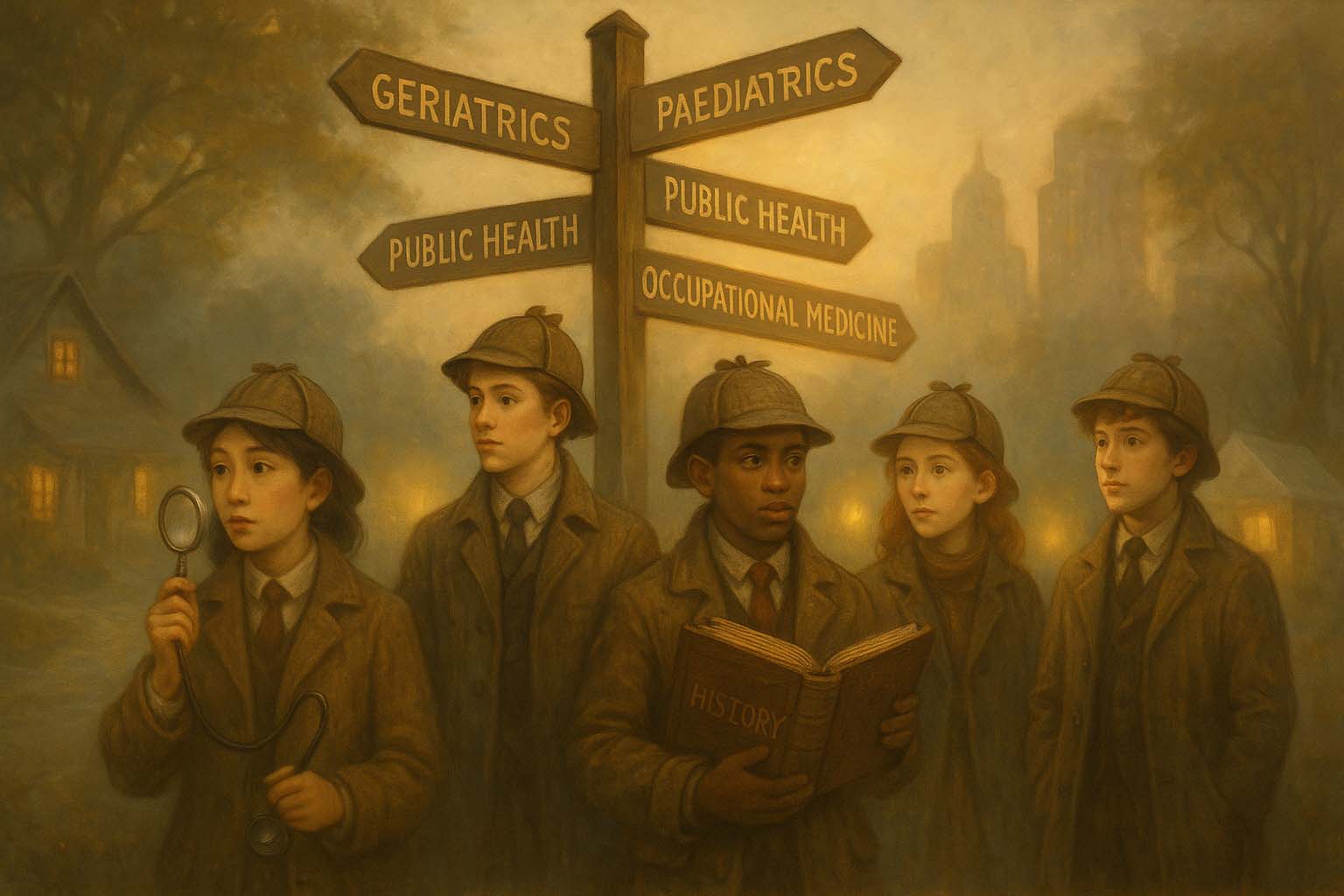
Is it the detective work of identifying an infection?
The precision of immune recognition?
The science of vaccination?
The mystery of autoimmune disease?
The urgency of stopping bleeding?
The slow architecture of wound healing?
Or the possibility of helping when the systems designed to protect someone have become overwhelmed, weakened or misdirected?
Am I inspired by the body’s continual struggle to defend, repair and restore itself?
Pause for a moment.
Notice whether protection, responsibility and restoration awaken something in you.
Begin World Six
Start with ELM-051: Why do we get infections?
The boundary has been crossed.
Now follow the body’s response.