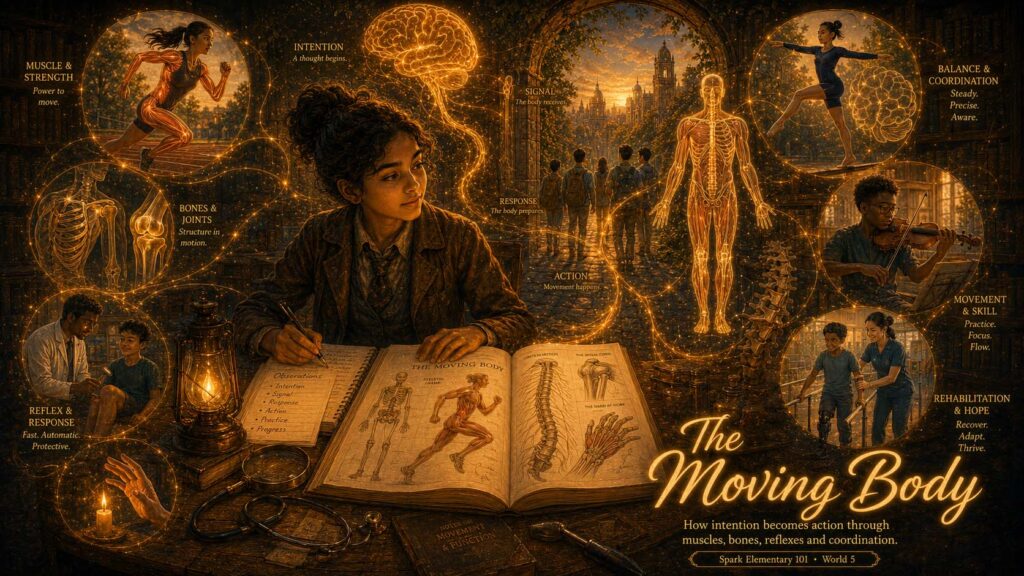
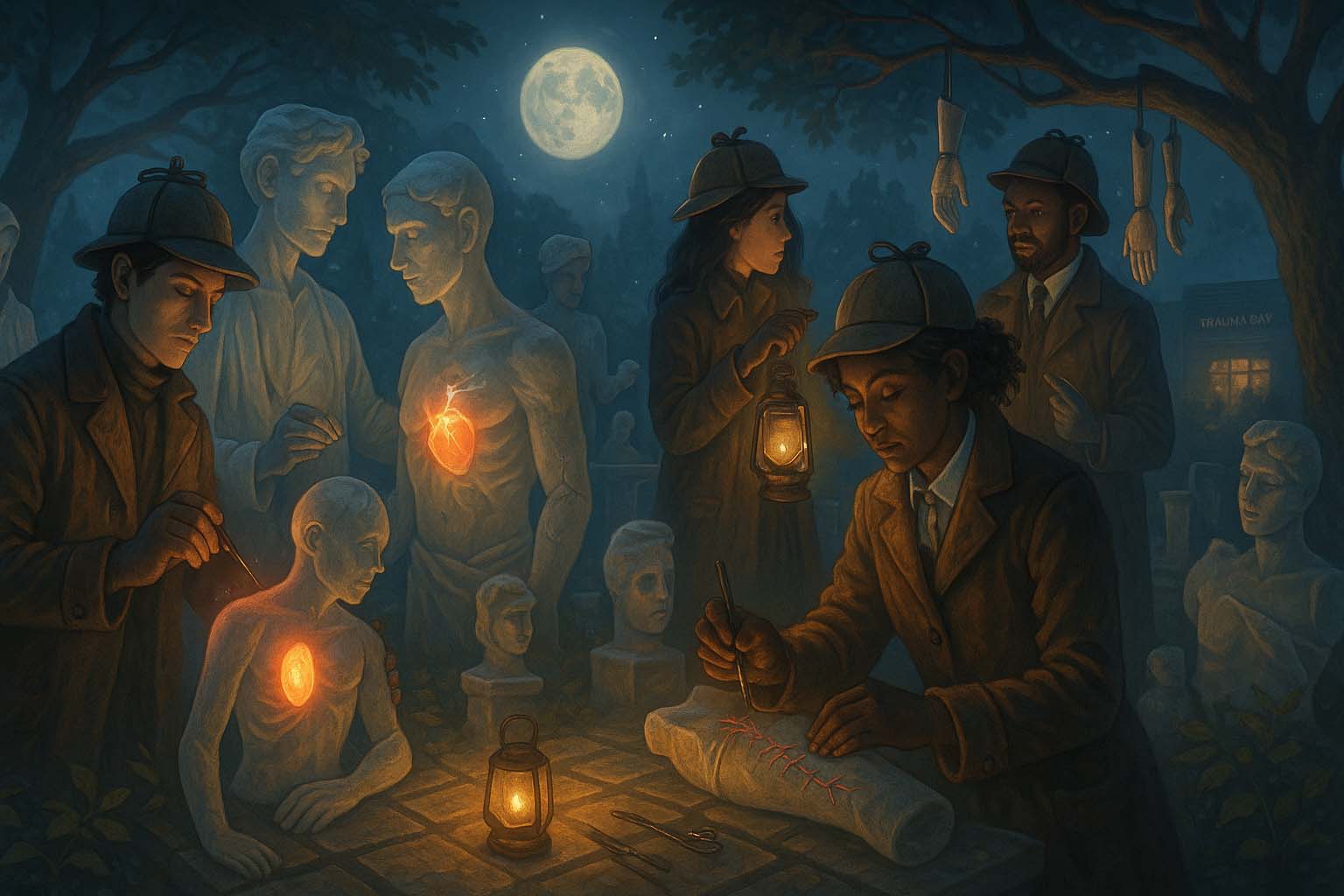
Decide to lift your hand.
Before it moves, an intention forms.
Signals travel from the brain, through the spinal cord and along a nerve. Muscle fibres contract. Tendons pull. Bones rotate around joints. Sensory messages return, telling the brain where the hand has moved and whether the action succeeded.
All of this happens in less time than it takes to describe it.
You can reach, write, catch, run, dance and speak without consciously directing every muscle involved.
How does a thought become movement?
Enter the World
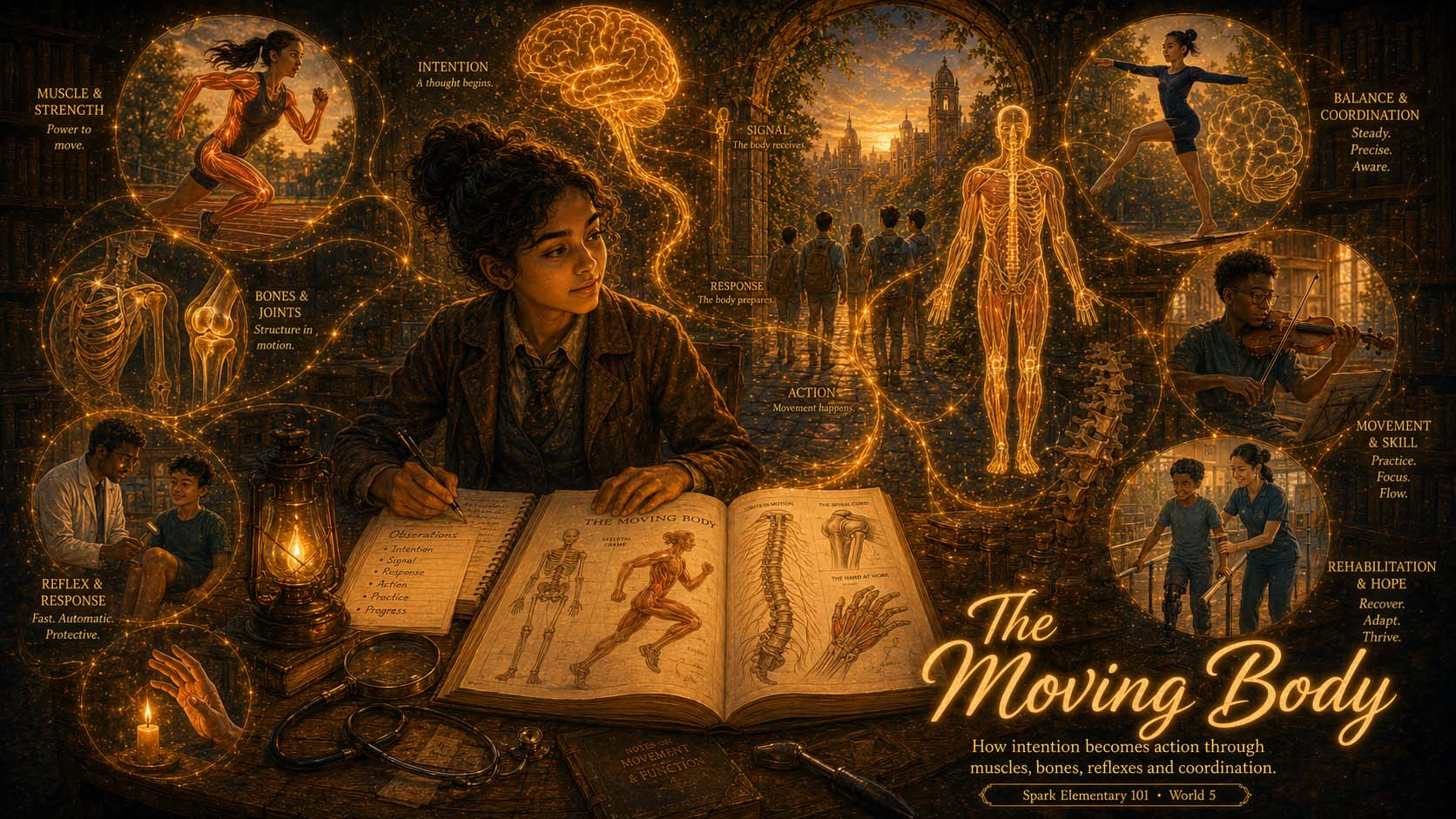
The Moving Body explores the remarkable journey from intention to action.
You will begin with a decision as simple as moving a finger and follow it through the brain, spinal cord, nerves and muscles.
You will discover how microscopic changes inside muscle fibres generate enough force to lift, jump or stand—and why that force eventually begins to fade with fatigue.
You will explore bones as living structures rather than lifeless scaffolding, and joints as carefully engineered meeting places that combine movement with stability.
Finally, you will investigate reflexes, balance, tremor and practice: the systems that allow the body to protect itself, remain upright and transform awkward effort into skill.
This is not simply a World about muscles and bones.
It is about how the whole body organises itself to act.
Three Paths Through the Moving Body
Muscle and Strength
Movement appears to begin with a thought.
But intention alone cannot lift an arm.
The nervous system must convert a plan into electrical signals, deliver them to the correct muscles and activate the right amount of force at precisely the right moment.
How do muscles pull bones?
What makes one person stronger than another?
And why does effort become harder even when the desire to continue remains?
Bones and Joints
Bones must solve an extraordinary engineering problem.
They must be strong enough to withstand running, jumping and falling, yet light enough to move. They must also remain living tissues capable of adapting and repairing themselves.
Joints face a different challenge.
They must allow hard bones to move against one another thousands of times without simply grinding away.
How do they achieve movement, stability and survival at the same time?
Reflexes, Balance and Coordination
Not every movement waits for conscious thought.
A hand withdraws from a hot surface before the brain has fully interpreted the pain.
A person walking across uneven ground makes countless small corrections without noticing them.
A beginner concentrates on every step of a new skill. With practice, the same movement becomes fluid and almost automatic.
How does the body protect, balance, correct and learn?
Ten Questions to Follow
ELM-041
How does a thought move a hand?
How does intention become a signal that travels from the brain to the spinal cord, nerve and muscle?
ELM-042
How do muscles move bones?
How does a microscopic contraction create enough force to bend an elbow, stand upright or jump?
ELM-043
Why do muscles become tired?
Why does force decline during repeated activity even when we still want to continue?
ELM-044
Why do bones not break every time we fall?
How can a skeleton remain light enough to move yet strong enough to absorb repeated force?
ELM-045
How do joints move smoothly without wearing away?
How do cartilage, fluid, ligaments and muscles allow movement while reducing friction?
ELM-046
Why do joints crack?
What produces clicks, pops and cracks—and do these sounds mean that damage is occurring?
ELM-047
Why do we pull away before we have time to think?
How can the spinal cord organise a protective movement before conscious awareness is complete?
ELM-048
How do we stay balanced while we move?
How do the eyes, inner ears, body-position senses and muscles work together to prevent a fall?
ELM-049
Why do we tremble?
Why can cold, fear, fatigue, low blood sugar or neurological illness make movement rhythmic or shaky?
ELM-050
Why does practice make movement easier?
How does an awkward, effortful action become faster, smoother and almost automatic?
Movement Is a Chain
To pick up a cup, the nervous system must estimate:
Where is the cup?
Where is the hand?
How far must the arm travel?
How heavy might the cup be?
How firmly should the fingers grip it?
Is it beginning to slip?
Does the movement need correcting?
The cup may be lifted in a second.
But the action depends upon a chain extending through:
intention
planning
brain
spinal cord
nerve
muscle
tendon
bone
joint
sensation
feedback
Movement succeeds because these parts do not work separately.
They listen and respond to one another.
Strength Is More Than Muscle Size
A larger muscle is not automatically a more effective movement.
Strength also depends upon:
how many muscle fibres are activated
when they are activated
how muscles work together
the position of the joint
the leverage of bones
the condition of tendons
balance and posture
pain and confidence
energy and fatigue
previous training
A person may have powerful muscles but poor coordination.
Another may generate normal force briefly but be unable to sustain it.
Someone else may understand exactly what they want to do while being unable to initiate or control the movement.
This gives medicine an important question:
Where in the journey from intention to action has movement been interrupted?
The difficulty may lie in the brain, spinal cord, nerve, muscle, bone, joint, balance system—or in pain, fear or exhaustion.
The outward problem may look similar.
Its meaning may be completely different.
Bones Are Alive
A skeleton may appear to be a fixed frame.
But bone is living tissue.
It contains cells and blood vessels. Old or damaged bone is removed. New bone is formed. Its internal structure changes in response to the forces placed upon it.
Bone combines two qualities:
Mineral provides hardness.
Collagen provides flexibility.
Its architecture distributes force while avoiding the weight of a completely solid structure.
Movement helps preserve bone.
Prolonged inactivity can weaken it.
A fracture therefore tells two stories:
How great was the force?
How strong was the bone that received it?
The same fall may leave one person bruised and another with a serious fracture.
Medicine must understand both the event and the body upon which it acted.
Control Matters as Much as Force
Skilled movement is not simply strong movement.
It is movement that is:
well timed
accurately directed
continuously monitored
efficiently corrected
adapted to changing conditions
A tremor does not necessarily mean that the muscles are weak. It may arise because the nervous system is producing rhythmic or unstable commands.
Poor balance may occur even when the legs are strong because the eyes, inner ears and body-position senses are giving conflicting information.
A reflex may protect the body by allowing the spinal cord to act before full conscious awareness arrives.
The Moving Body reveals that control can matter as much as power.
Practice Changes the Body
Think of learning to write, ride a bicycle, play an instrument or catch a ball.
At first, movement demands attention.
It may be slow, uneven and exhausting.
With practice, the nervous system begins to predict what will happen next. Unnecessary movements are reduced. Timing improves. Errors are detected earlier. The action becomes smoother and requires less conscious effort.
Practice does not merely reveal an existing ability.
Practice changes the networks that create the ability.
This is why rehabilitation matters.
After injury or illness, the nervous system may learn new pathways, strengthen surviving connections and develop different ways of achieving a goal.
Recovery may not always mean returning to exactly how the body moved before.
Sometimes it means finding another route towards independence.
When Movement Changes
Losing movement can alter far more than physical function.
It may affect:
independence
communication
work
identity
relationships
confidence
participation in ordinary life
A person who cannot move as they once did may still understand, intend, feel, choose, communicate and adapt.
They remain more than their movement.
Medicine must never reduce someone to the limb that is weak, the hand that trembles or the distance they can walk.
The deeper task is not simply to ask:
Can we make this muscle stronger?
It is to ask:
What does this person want movement to make possible again?
That might be walking to the garden.
Holding a child.
Writing a name.
Feeding oneself.
Returning to work.
Or finding a new way to participate when restoration is incomplete.
The Calling Question
You have followed a thought from the brain into the hand.
You have watched muscle fibres create force, bones withstand impact and joints allow movement.
You have encountered reflexes, balance, tremor and the slow transformation of practice into skill.
What draws you closer?
Is it the electrical pathway from intention to action?
The engineering of muscles, tendons and bones?
The precision of balance and coordination?
The mystery of tremor?
The detective work of locating where movement has failed?
The adaptability of the nervous system?
Or the possibility of helping someone regain not only movement, but choice, confidence and independence?
Do I wonder how intention becomes action, and what it means when the body can no longer move as it once did?
Pause for a moment.
Notice whether the science of movement—and the human meaning of restoring it—makes you want to step closer.
Begin World Five
Start with ELM-041: How does a thought move a hand?
The movement begins before the hand has moved.
Now follow the signal.