Close your eyes.
Tonight, the world around you will gradually disappear from awareness.
Your body may lie still while your brain passes through changing states. You may dream of people who are not present, visit places that do not exist and awaken with only fragments of the journey remaining.
Tomorrow, you will recognise faces, forget names, learn something new, feel fear, share laughter and make decisions without always knowing why.
Somewhere within the activity of billions of brain cells, a moment becomes a memory, a situation becomes an emotion and a living body becomes someone who can say:
I am me.
How does that happen?
Enter the World
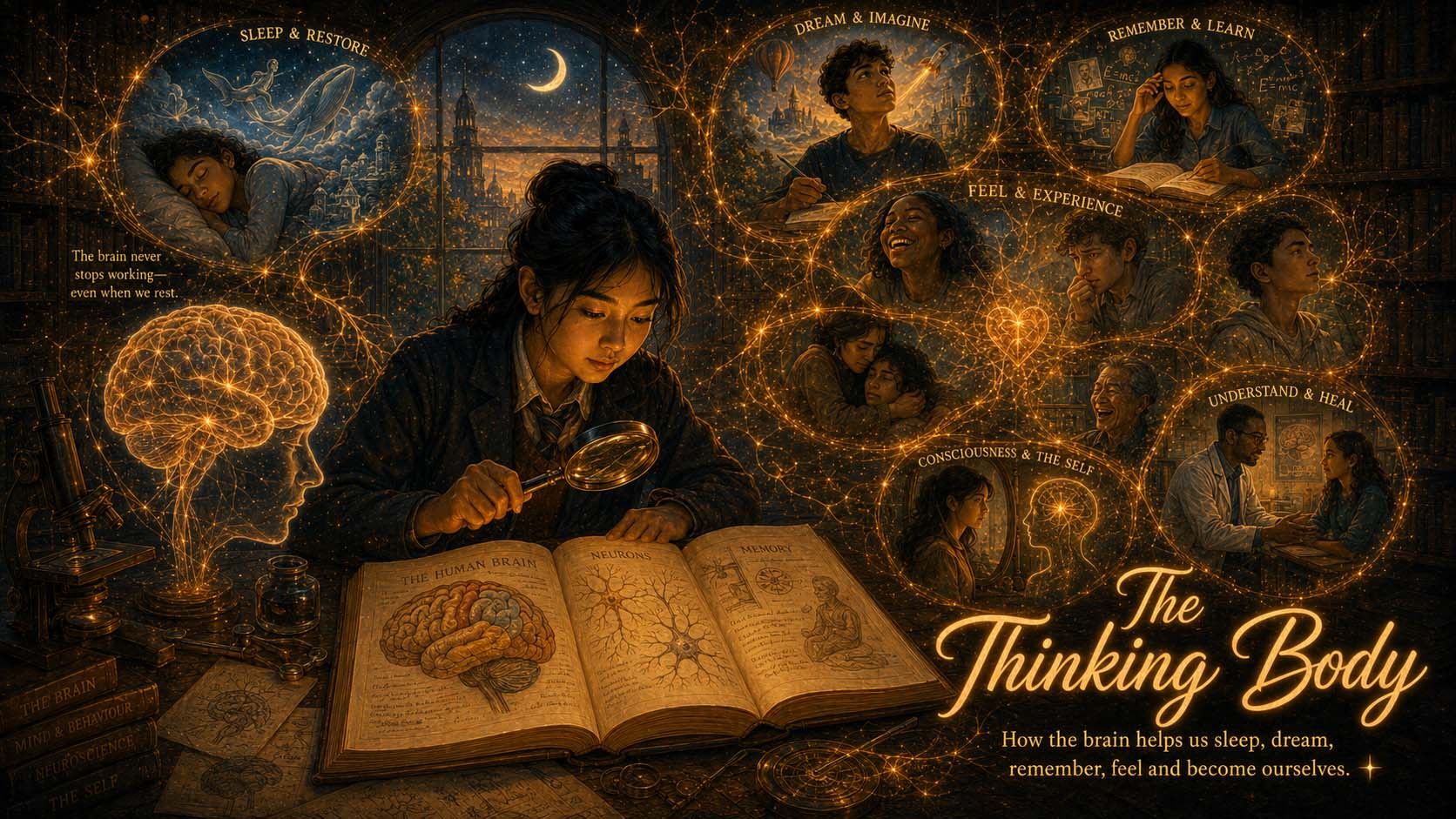
The Thinking Body explores the mysteries that make us more than organisms that breathe, eat and move.
You will begin with sleep, when awareness of the outside world recedes.
You will enter the strange landscapes of dreams, where the brain creates convincing experiences without the usual information from the senses.
You will discover how experience changes the brain, how memories are formed and why some remain while others fade.
You will explore emotions, fear and laughter—not as interruptions to thought, but as essential ways through which the brain guides action, protects us and connects us with other people.
Finally, you will approach questions that medicine and neuroscience have not yet fully answered:
What makes us conscious?
And how does a brain come to know that it is itself?
Four Paths Through the Thinking Body
Sleep and Dreams
Every night, awareness loosens its hold on the outside world.
Yet sleep is not the brain switching off. It is an active, changing state in which the body regulates, repairs and prepares itself.
Why must we sleep? Why does the sleeping brain create dreams? And where does awareness go while we are no longer conscious of the room around us?
Memory and Learning
Every experience has the possibility of leaving a trace.
Practice may become skill. A passing moment may become a lifelong memory. A face may remain familiar while its name disappears.
How does learning alter the brain? How does the present become the past? And why is memory less like a recording and more like a story rebuilt each time it is recalled?
Emotion and Behaviour
Emotion is not the opposite of reason.
It helps the brain decide what matters, what requires attention, what should be approached and what should be avoided.
Why does fear make the heart race? Why can an old memory still produce a physical response? And why does laughter spread so easily between people?
Consciousness and the Self
The brain does more than process information.
It creates an experience of being awake, present and located within a body. It connects memory, emotion, perception and relationship into a continuing sense of “me”.
But is the self stored somewhere in the brain?
Or is it something the brain must continually assemble?
Ten Questions to Follow
ELM-021
Why do we sleep?
Why must awareness disappear for several hours each day—and what is the brain accomplishing while we sleep?
ELM-022
Why do we dream?
How can the sleeping brain create vivid worlds, emotions and stories without ordinary sensory input?
ELM-023
How does the brain learn?
How can practice and experience produce lasting changes in knowledge, skill and behaviour?
ELM-024
How does an experience become a memory?
How does something happening now become something the brain can revisit years later?
ELM-025
Why do memories fade?
Why do some moments remain vivid for decades while others disappear within hours?
ELM-026
Why do we forget names?
Why can we recognise a familiar face, remember where we met and still be unable to retrieve the person’s name?
ELM-027
Why do we have emotions?
What do feelings contribute to survival, decision-making, relationships and the way we understand the world?
ELM-028
Why do we feel fear?
How does the brain recognise danger and prepare the heart, lungs, muscles and attention to respond?
ELM-029
Why do we laugh?
Why is laughter contagious, deeply social and sometimes present even when nothing is especially funny?
ELM-030
How does the brain know that it is itself?
How do awareness, memory, body perception and relationships combine into a continuing sense of “me”?
The Brain Is Not Simply a Computer
The brain does not merely receive information, store it and produce an answer.
It predicts.
It interprets.
It filters.
It selects what matters.
It connects the present with the past.
It prepares the body to act.
It continually constructs a version of the world—and a place for us within it.
Two people may encounter the same event and experience it very differently because each brain brings its own memories, expectations, emotions and history.
A sound may be harmless to one person and terrifying to another.
A smell may pass unnoticed by one person and transport another instantly into childhood.
A face may remain familiar even when the name attached to it cannot be found.
The Thinking Body reveals that human experience is not a perfect recording of reality.
It is something the brain actively creates.
What Happens to Us Leaves Traces Within Us
Learning changes the brain.
Memory allows the past to return.
Emotion gives experience meaning.
But these processes are not flawless.
Memories can fade, change or become difficult to retrieve.
Fear can protect us from danger, but it can also continue after the danger has passed.
Sleep can restore us, yet it can also be disturbed by illness, anxiety or trauma.
A person may be awake without being fully aware.
Another may be unable to communicate while still possessing an inner experience.
This leads to one of medicine’s most important lessons:
A person’s experience is real even when it cannot be seen directly.
Pain, fear, sadness, confusion, memory loss and altered awareness are experienced from within.
Medicine must approach them through careful observation, conversation, examination and trust.
When the Self Changes
Illness or injury can alter memory, personality, awareness and the sense of belonging within one’s own body.
A person with dementia may no longer remember a shared event, yet still respond warmly to a familiar voice or piece of music.
A person emerging from a coma may show awareness before they can express it clearly.
Someone experiencing depersonalisation may know logically who they are while feeling strangely detached from themselves.
These experiences raise profound questions.
If memory changes, does the person disappear?
If someone cannot speak, how do we know what remains within?
Where does personhood reside?
Medicine cannot reduce a human being to memory, intelligence or independence.
Even when the mind changes, the person remains deserving of dignity, relationship and recognition.
The Mystery Remains Open
Science can describe many of the networks involved in sleep, learning, memory, emotion and awareness.
It can show how injury changes experience.
It can observe which brain systems become active.
It can increasingly explain the conditions that allow consciousness to occur.
But one mystery remains:
Why does brain activity feel like anything from the inside?
How does electrical and chemical activity become the experience of colour, grief, love, memory or selfhood?
The Thinking Body invites the learner into a part of medicine where knowledge is advancing rapidly, but humility remains essential.
Sometimes the most exciting questions are not those medicine has already answered.
They are those it is still learning how to ask.
The Calling Question
You have watched awareness disappear into sleep.
You have entered the uncertain world of dreams.
You have followed experience as it becomes learning, memory and identity.
You have seen fear transform the body and laughter connect one person with another.
And you have approached the unresolved mystery of consciousness itself.
What draws you closer?
Is it the structure of sleep?
The strangeness of dreams?
The adaptability of the brain?
The fragility of memory?
The power of emotion?
The human stories of dementia, trauma or altered awareness?
Or the possibility of standing beside someone when their memories, emotions or sense of self are changing?
Am I drawn towards the mysteries that make a person think, feel, remember and become themselves?
Pause for a moment.
Notice what this World has made you wonder about—not only in the brain, but within yourself.
Begin World Three
Start with ELM-021: Why do we sleep?
Your brain has spent every night entering another state.
Now follow it into the mystery.