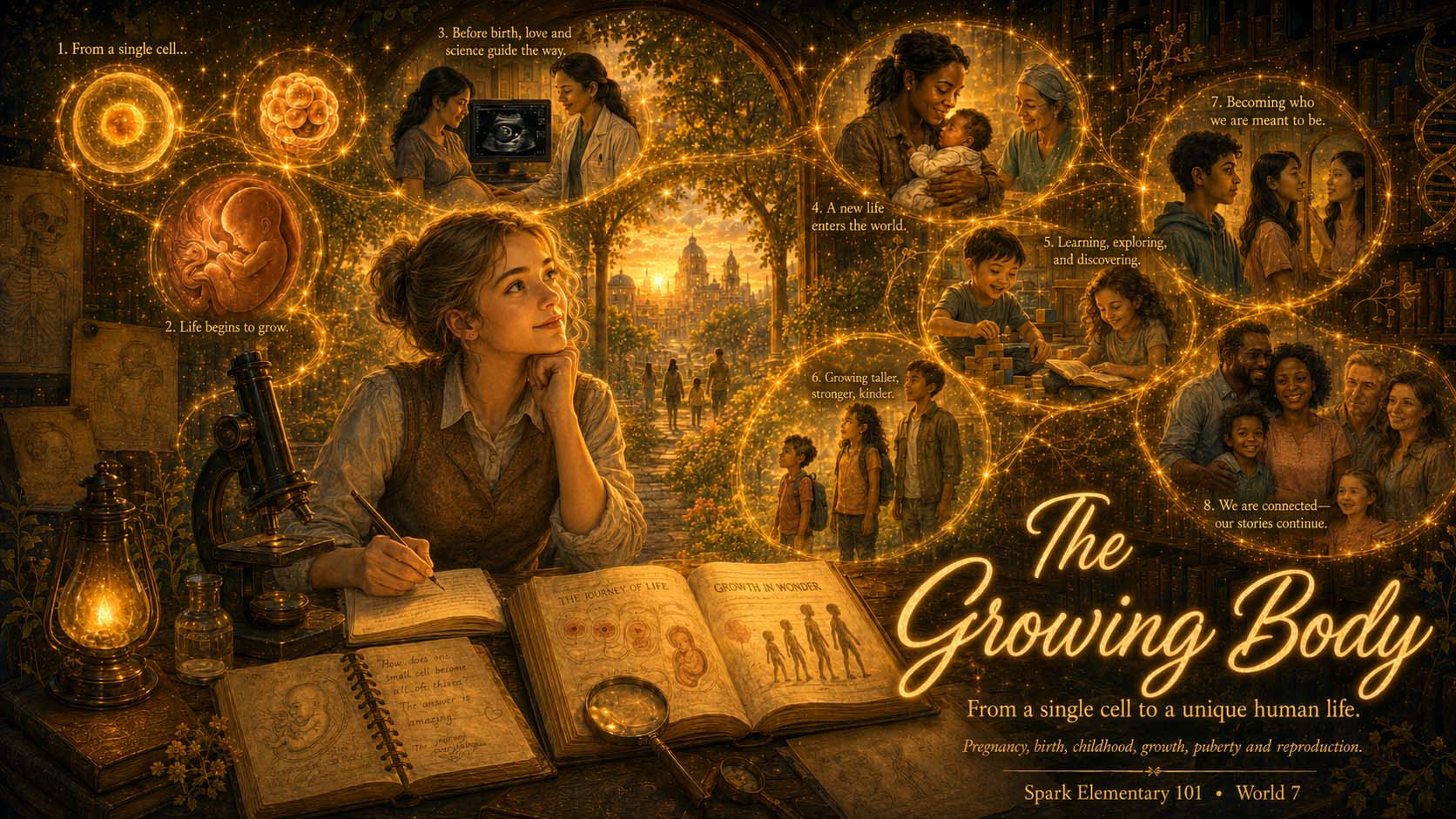
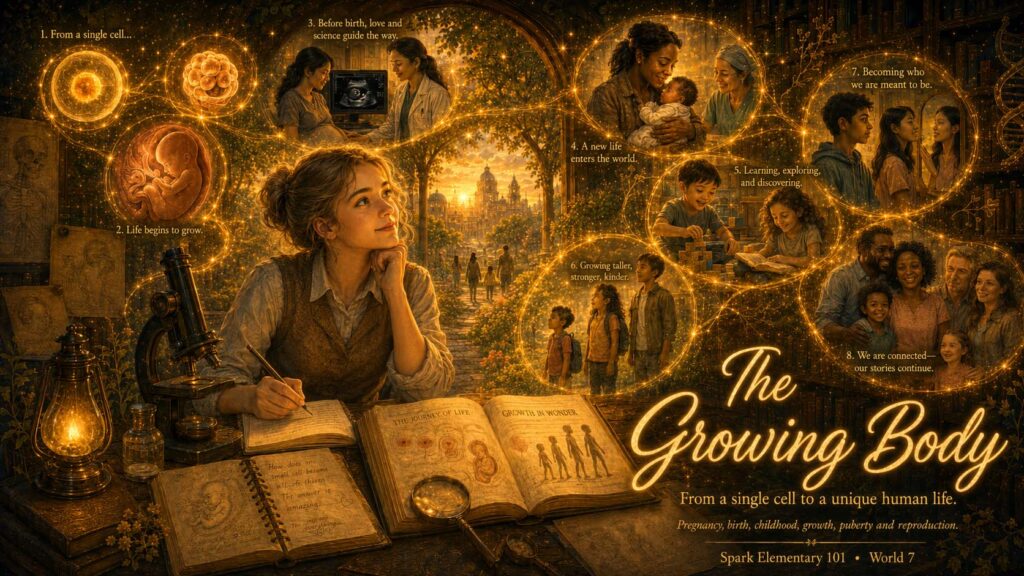
Every person begins smaller than a full stop.
One cell divides into two.
Two become four.
Cells multiply, move and begin to specialise. Tissues form. Organs emerge. A heart begins to beat. Limbs take shape. A brain develops.
Months later, a baby enters the world—entirely human, yet dependent upon others for warmth, nourishment, protection and connection.
That baby will grow, learn, change and eventually become capable of creating another generation.
How does one cell become a person?
Enter the World
The Growing Body follows human life from its earliest biological beginning through development before birth, infancy, childhood, puberty and inheritance.
You will begin with a single fertilised cell and discover how repeated division produces not simply more cells, but an organised human body.
You will explore how cells containing almost identical DNA become skin, muscle, blood and brain.
You will follow oxygen and nutrients across the placenta and witness the extraordinary transition at birth, when the lungs expand and a baby enters an entirely new environment.
Then you will journey through childhood and puberty, exploring why babies cry, why children grow at different rates and how inherited information creates family resemblance without ever producing an exact copy.
This is not simply a World about becoming bigger.
It is about becoming organised, capable, connected and increasingly oneself.
Four Paths Through the Growing Body
Before Birth
A fertilised cell contains no miniature heart, brain or skeleton.
The body must be created gradually through cell division, signalling, movement and organisation.
How does one cell become trillions?
Why do cells with the same DNA develop different identities?
And how can a baby grow before breathing air or eating food?
Birth and Babies
Birth is one of the most dramatic transitions in human life.
Within minutes, the lungs must expand, placental support must end and the circulation must change. The newborn must begin regulating temperature, feeding and communicating in a new world.
Yet human babies remain unusually dependent.
Why are we born needing so much care?
And what is a baby communicating when they cry?
Childhood and Growth
Children do not all grow at the same speed.
Height, development and physical change are influenced by genes, hormones, nutrition, health and the timing of maturation.
Why do growth patterns differ?
Why does the body first build baby teeth and then replace them?
And how can medicine recognise when variation is ordinary and when a child may need help?
Puberty and Reproduction
Puberty transforms the child’s body towards reproductive maturity.
Hormones alter growth, skin, body composition, voice, reproductive organs and emotional experience.
The final questions travel beyond one life into the next generation.
Why do we resemble our biological parents?
And why is every person unmistakably themselves?
Ten Questions to Follow
ELM-061
How does one cell become a human being?
How can repeated cell division create tissues, organs, limbs and an organised body rather than simply a growing cluster of identical cells?
ELM-062
How do cells know what to become?
If skin cells and brain cells contain almost the same DNA, why do they look and behave so differently?
ELM-063
How does a baby grow before birth?
How do oxygen and nutrients reach a developing fetus—and how are waste products removed without the fetus breathing air or eating food?
ELM-064
Why are babies born so dependent upon other people?
Why can many animals move soon after birth while human infants require years of protection, learning and care?
ELM-065
Why do babies cry?
How does a baby communicate hunger, pain, discomfort, tiredness and the need for connection without language?
ELM-066
Why do children grow at different rates?
How do genes, hormones, nutrition, illness and developmental timing shape the path from infancy to adulthood?
ELM-067
Why do we lose our baby teeth?
Why does the body create one set of teeth, only to replace it with another as the jaw and face grow?
ELM-068
Why does puberty happen?
What signals begin the transition from childhood towards reproductive maturity?
ELM-069
Why do we resemble our parents?
How does biological information travel through egg and sperm from one generation to the next?
ELM-070
Why is every person biologically unique?
Why are siblings different—and why is no child simply a copy of either biological parent?
Development Is More Than Division
A human being is not a miniature adult waiting to become larger.
The body must be built in stages.
Cells must:
divide
move
communicate
learn their position
respond to neighbouring cells
activate particular genes
form tissues
create boundaries
and sometimes disappear at precisely the right time
Developing fingers, for example, begin within broader paddles of tissue. Cells between the future fingers are removed as development continues.
Building a body therefore requires more than adding.
Sometimes creation also requires careful subtraction.
The developing body must continually answer:
Where am I?
What should I become?
Which cells are beside me?
Which direction should I grow?
When should I divide?
When should I stop?
Development is multiplication guided by pattern.
The Same Library, Different Chapters
Almost every cell contains the same genetic library.
But cells do not read every instruction at once.
A muscle cell activates genes involved in contraction and energy use.
A neuron activates genes involved in electrical communication.
A blood cell uses another set of instructions.
A skin cell uses another.
Signals from neighbouring cells, hormones and the cell’s own history help determine which genes are active.
This is how one set of DNA can contribute to hundreds of different cell types.
A cell’s identity depends not only upon the genes it possesses, but upon the genes it is using.
This principle opens the door to some of medicine’s most exciting fields:
stem-cell treatment
bone-marrow transplantation
regenerative medicine
genetic disease
cancer research
and the possibility of repairing damaged tissues
The Placenta Is a Temporary Lifeline
Before birth, the fetus does not breathe through its lungs or eat through its digestive system.
The placenta becomes the bridge between maternal and fetal physiology.
Across specialised placental structures:
oxygen passes towards the fetus
nutrients cross to support growth
carbon dioxide and waste products return
hormones help regulate pregnancy
immune interactions are modified
and growth is continually supported
Maternal and fetal blood normally travel close to one another without mixing freely.
The placenta is therefore not merely a filter.
It is a temporary organ of exchange, signalling and support.
It acts, in part, as the fetus’s lungs, nutrient supply and waste-removal system.
Yet it is not a perfect barrier. Some medicines, infections, alcohol, nicotine and other substances can cross it.
Pregnancy therefore involves extraordinary biology—but also uncertainty, complexity and lives that cannot be reduced to blame.
Birth Changes Everything
Before birth, oxygen comes from the placenta.
At birth, that support ends.
The newborn’s first breaths expand fluid-filled lungs.
Blood flow through the lungs increases.
Temporary pathways in the fetal circulation begin to close.
The baby must begin maintaining body temperature, feeding and signalling distress in an unfamiliar environment.
Birth is not simply a change of location.
It is a rapid transformation of almost every system that has sustained life until that moment.
For most babies, this transition happens naturally.
Others—particularly those born prematurely or unwell—may need help with breathing, warmth, circulation or feeding.
A premature baby is not simply a smaller full-term baby.
Their organs may still be at an earlier stage of maturation.
Medicine must therefore understand not only size, but developmental readiness.
Dependence Is Part of the Human Story
Human infants are born profoundly dependent.
This is not developmental failure.
The human brain continues developing for many years after birth. Prolonged childhood creates time for language, social learning, imagination, culture and complex relationships to emerge.
But that possibility requires care.
A baby cannot independently obtain food, seek shelter or regulate emotion.
They survive through other people.
Crying becomes one of their earliest forms of communication.
It may signal:
hunger
pain
tiredness
temperature discomfort
overstimulation
illness
or the need for closeness
Crying is not manipulation.
It is communication before language.
A baby’s development therefore occurs not only inside the body.
It unfolds within relationship.
Development Is a Pathway, Not a Race
Children do not all:
walk at the same age
speak at the same time
grow at the same speed
enter puberty together
or develop identical strengths
Variation is part of normal human development.
Growth charts are not rankings.
They allow clinicians to observe patterns across time.
A child who is shorter than classmates may be healthy if they follow a steady growth pathway consistent with their family.
A child who is average height but suddenly stops growing may require closer attention.
The meaning lies not in one measurement alone, but in the trajectory.
Medicine must balance two responsibilities:
Do not turn normal difference into disease.
Do not overlook a child who needs support.
Development should be observed with curiosity rather than comparison.
Growing Requires More Than Biology
Genes and hormones matter.
So do:
nutrition
sleep
health
movement
safety
stimulation
education
culture
relationship
and belonging
A child may possess the biological capacity to grow, but still need the right conditions in which that capacity can unfold.
Medicine therefore supports development not only by treating illness.
It also asks whether a child has access to nourishment, care, protection, learning and connection.
The growing body exists within a growing life.
Puberty Is a Transition, Not a Single Moment
Puberty begins when changing signals between the brain, pituitary gland and reproductive organs activate a new hormonal phase.
Growth accelerates.
Body composition changes.
Reproductive organs mature.
Skin, hair, voice and body odour may change.
Emotions and sleep patterns may also feel different.
Puberty does not occur at one universally correct age.
Its timing and sequence vary.
For a young person, these changes may bring curiosity, excitement, embarrassment, uncertainty or distress.
Medicine must therefore explain development without judgement and recognise that biological development, gender identity and personal experience are related but not interchangeable.
Care begins with accurate science.
It continues through respectful listening.
Inheritance Creates Resemblance, Not Copies
Biological parents pass DNA through egg and sperm.
Each usually contributes one chromosome from every pair.
But before reproductive cells are formed, genetic material is shuffled and recombined.
At fertilisation, one unique egg meets one unique sperm.
Development is then influenced by:
new genetic variation
the environment before birth
nutrition
illness
experience
relationships
learning
and chance
This is why family members can resemble one another without becoming identical.
Even identical twins, who begin with almost the same DNA, may develop differences through experience, environment and changes in gene activity.
Genes influence possibility.
They do not write every detail of a life.
Inherited risk is not destiny.
A Person Is More Than Their DNA
Genetics can reveal important information about disease risk, inherited conditions and treatment.
But DNA cannot fully describe:
personality
values
relationships
culture
talents
choices
or the meaning of a life
A person may carry features from many generations while becoming someone who has never existed before.
Biological inheritance is part of identity.
It is not the whole of identity.
Family, too, is larger than genetics.
Human beings may grow within biological, adoptive, donor-conceived, fostered, blended and many other forms of family.
The Growing Body therefore ends with a paradox:
We belong to a human story that began long before us, yet each of us arrives as something new.
Medicine Accompanies Becoming
Medicine does not care only for completed adult bodies.
It accompanies life while it is still emerging.
It may support:
a pregnancy filled with hope and uncertainty
a fetus growing more slowly than expected
a premature baby learning to breathe and feed
an exhausted parent trying to understand a baby’s cry
a child whose growth has changed
a young person entering puberty earlier or later than friends
or a family considering genetic information that offers probability but not certainty
In these moments, care requires more than technical knowledge.
It requires sensitivity to vulnerability, expectation, grief, hope and the future a family has begun to imagine.
The Calling Question
You have followed a single cell as it divided, specialised and organised itself into a developing human body.
You have watched the placenta sustain life before birth and seen a newborn cross into a new world.
You have encountered infant dependence, childhood growth, puberty, inheritance and biological uniqueness.
What draws you closer?
Is it the precision of embryonic development?
The mystery of cell specialisation?
The physiology of pregnancy and birth?
The vulnerability of newborn life?
The long unfolding of childhood?
The transformation of puberty?
The patterns of genetics and inheritance?
Or the possibility of accompanying a person and family through moments of hope, uncertainty and change?
Am I moved by the journey through which a single cell becomes a unique human life?
Pause for a moment.
Notice whether beginnings, development and human possibility awaken something in you.
Begin World Seven
Start with ELM-061: How does one cell become a human being?
Every human story begins with one cell.
Now follow what it becomes.