
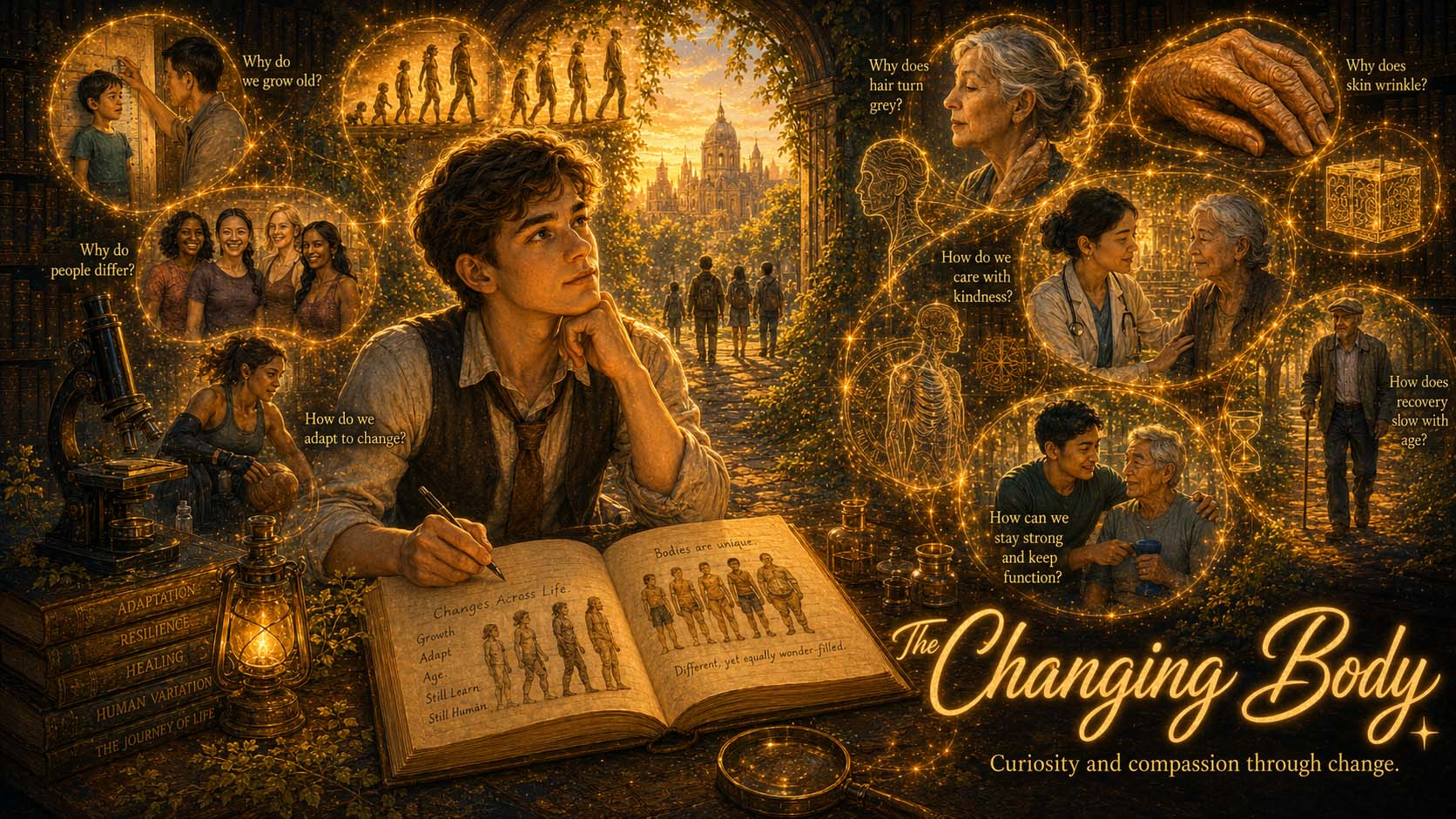
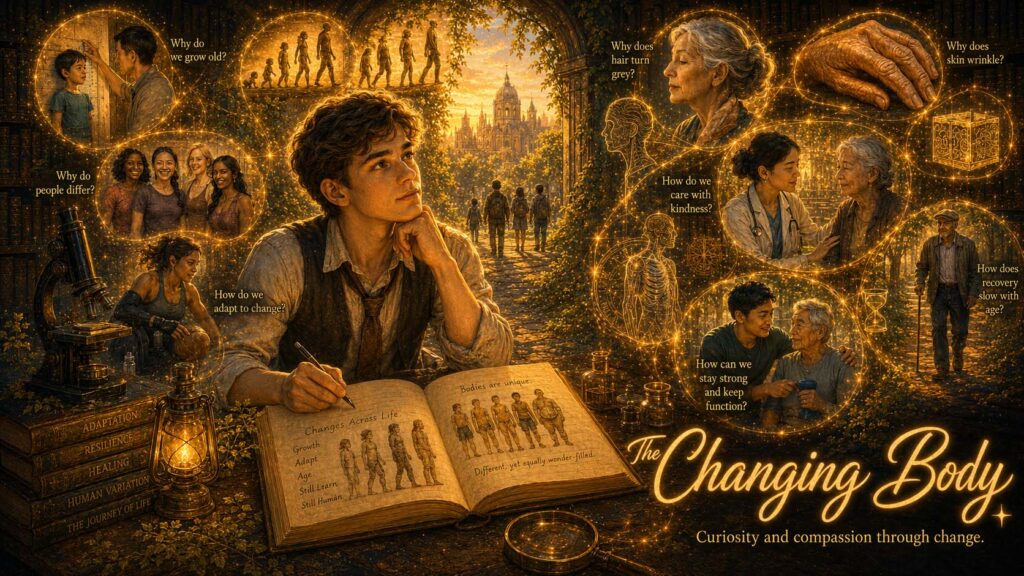
World 9: THE CHANGING BODY
How difference, adaptation and ageing shape every human life
Stand several people beside one another.
They differ in height, strength, appearance, metabolism and susceptibility to illness.
Give them the same exercise programme and their bodies will adapt differently.
Expose them to the same infection and their experiences may range from no symptoms to serious disease.
Then allow time to pass.
Hair changes colour. Skin changes texture. Muscles, bones, senses and organs gradually alter.
Some people remain vigorous into advanced age.
Others become vulnerable much earlier.
Why are our bodies different—and why do they keep changing throughout life?
Enter the World
The Changing Body explores two truths at the heart of medicine:
No two bodies are exactly alike.
No body remains exactly the same.
You will begin with human variation, discovering why people differ in height and why the same illness can affect two people so differently.
You will then explore adaptation: how exercise reshapes the heart, muscles and nervous system, and how the body adjusts to heat, cold and reduced oxygen at altitude.
From there, you will follow the visible signs of passing time—grey hair and changing skin—towards the deeper biology of ageing.
Finally, you will encounter recovery, frailty and physiological reserve: why some people remain resilient while others can experience a major decline after a seemingly small illness.
This is not simply a World about growing older.
It is about the body continually changing in response to inheritance, environment, experience and time.
Four Paths Through the Changing Body
Human Variation
Medicine often compares people with averages.
Average height.
Average blood pressure.
Average development.
Average response to treatment.
But an average is not an instruction that every body must follow.
Why are some people taller than others?
Why can the same virus be barely noticed by one person and life-threatening to another?
And when does a difference represent normal variation rather than disease?
Adaptation
The body responds to what is repeatedly asked of it.
Run regularly and the same distance may begin to feel easier.
Lift weights and the muscles and nervous system become better at producing force.
Spend time in heat and sweating may begin earlier.
Travel to altitude and breathing, blood and circulation begin adjusting to reduced oxygen.
The body is not fixed.
It is continually rewriting its capabilities in response to demand.
Ageing
Grey hair and wrinkles are visible signs of time.
But ageing reaches much further beneath the surface.
Cells accumulate damage. Repair becomes less complete. Proteins, mitochondria, immune systems and organs gradually change.
Why can the body repair itself for decades but not maintain every structure perfectly forever?
And why do two people of the same age sometimes appear biologically very different?
Frailty and Decline
Frailty is not another word for old age.
It describes a loss of reserve—the spare capacity that allows the body to withstand illness, injury and sudden change.
Why does recovery sometimes become slower?
Why do some people remain strong while others become increasingly vulnerable?
And how can a small infection lead to confusion, falls or loss of independence?
Ten Questions to Follow
ELM-081
Why are people different heights?
How do genes, hormones, nutrition, health and the timing of development combine to shape adult height?
ELM-082
Why do people respond differently to the same illness?
Why can the same infection, injury or medicine have very different effects on different people?
ELM-083
How does the body adapt to exercise?
Why does repeated activity make movement stronger, more efficient and less exhausting?
ELM-084
How does the body adapt to heat, cold and altitude?
How can repeated exposure change sweating, circulation, metabolism and oxygen transport?
ELM-085
Why does hair turn grey?
Why do hair follicles gradually produce new hairs with less pigment?
ELM-086
Why does skin wrinkle?
How do collagen, elastin, sunlight, repeated expression and time change the structure of the skin?
ELM-087
Why do we grow old?
Why does biological damage accumulate while repair and regulation gradually become less complete?
ELM-088
Why does recovery become slower with age?
Why may healing, rebuilding strength and returning to normal life take longer in later years?
ELM-089
Why do some people become frail while others remain strong?
How do illness, activity, nutrition, cognition, social circumstances and physiological reserve shape resilience?
ELM-090
Why can a small illness cause a big decline in an older person?
Why can a minor infection or brief hospital stay lead to confusion, falls, weakness or loss of independence?
Variation Is Part of the Pattern
People differ because life is built from variation.
Genes are reshuffled between generations.
Development unfolds within different bodies and environments.
People experience different:
nutrition
illnesses
physical activity
stress
housing
education
healthcare
relationships
opportunities
and exposures
Variation may be harmless, helpful or clinically important.
A person may be outside the population average without being unwell.
Another may fall within the average range while showing a significant change from their own previous health.
Medicine therefore cannot ask only:
Is this person different from everyone else?
It must also ask:
What does this difference mean for this person?
Averages Are Maps, Not Destinations
A growth chart can help clinicians follow a child’s development.
But it is not a competition.
Two children may be the same height today.
One has always followed a shorter but steady growth pathway.
The other has stopped following their previous pattern.
Their measurements are identical.
Their stories are not.
A single number rarely explains a life.
Blood pressure, weight, temperature, laboratory results and physical ability must all be understood in context.
The Changing Body introduces an essential principle:
Medicine recognises patterns, but it cares for individuals.
The Same Illness Never Enters the Same Body Twice
Two people may encounter the same virus.
But the virus does not enter identical biological worlds.
Each person brings a different combination of:
age
genetics
previous infection
vaccination
immune response
organ function
existing illness
nutrition
medicines
environment
and access to care
Social conditions matter alongside biology.
A person who can rest, isolate, obtain treatment and eat well may experience illness differently from someone who must continue working, lives in overcrowded housing or cannot easily access healthcare.
These are not competing explanations.
They interact.
The same diagnosis may therefore produce different symptoms, severity, recovery and treatment needs.
Equal care does not always mean giving everyone precisely the same thing.
Sometimes fairness requires care to be adapted to the person.
The Body Becomes What It Is Asked to Do
The first run may feel difficult.
The heart races.
Breathing becomes heavy.
Muscles tire.
Weeks later, the same route feels easier.
The route has not changed.
The body has.
With repeated exercise:
the heart may pump more blood with each beat
muscles may develop a greater blood supply
muscle fibres may grow
energy systems may become more efficient
the nervous system may improve timing and coordination
bones may respond to appropriate loading
and movement may require less conscious effort
But adaptation is specific.
Running develops different capabilities from lifting weights.
Balance practice produces different changes from stretching.
The body adapts towards the challenge it repeatedly encounters.
The Body Also Adapts to Inactivity
Adaptation is not always improvement.
When movement stops, the body receives a different message.
It may begin reducing capacities that no longer appear necessary.
After prolonged bed rest:
muscle strength falls
endurance declines
balance worsens
confidence may diminish
and ordinary activities become harder
This is called deconditioning.
It explains why someone may recover from an infection yet remain unable to walk as they did before entering hospital.
The disease may have been treated.
The person’s function has not yet been restored.
The body adapts to activity.
But it also adapts to inactivity.
Adaptation Requires Challenge and Recovery
Exercise creates stress.
Muscle fibres experience microscopic disruption.
Energy stores are used.
The nervous system is challenged.
Improvement occurs as the body rebuilds during recovery.
Too little challenge produces little change.
Too much challenge without recovery may produce:
injury
exhaustion
declining performance
sleep disturbance
or illness
Growth therefore occurs in the space between demand and restoration.
This principle extends beyond sport.
Rehabilitation after illness or injury must also find the right balance:
enough challenge to encourage adaptation
enough support to prevent harm
and enough time for rebuilding to occur
The Environment Leaves Its Signature
During the first days of hot weather, exercise may feel exhausting.
After repeated safe exposure, sweating may begin earlier and become more efficient.
At altitude, even gentle walking may initially cause breathlessness.
Over time, the body may increase breathing, alter fluid balance and produce more red blood cells.
This gradual adjustment is called acclimatisation.
But adaptation has limits.
A person accustomed to heat can still develop heatstroke.
A fit traveller can still become seriously unwell at altitude.
The body can negotiate with the environment.
It cannot always defeat it.
Medicine must understand both the body’s capacity to adapt and the point at which that capacity is exceeded.
Time Becomes Visible
Grey hair appears when new hairs grow with less pigment.
Wrinkles emerge as collagen, elastin, hydration, fat distribution and tissue repair change.
Sunlight, smoking, pollution and repeated environmental exposure may accelerate some changes.
Facial movement also leaves its traces.
Smiling, concentrating, laughing and squinting repeatedly fold the skin.
Over time, some of these lines remain visible at rest.
A face therefore carries more than biological age.
It may carry:
sunlight
work
expression
environment
illness
genetics
and history
A face without lines is not the definition of a healthy or meaningful life.
Some changes are not defects to erase, but evidence that a life has been lived.
Ageing Is Not One Clock
There is no single switch that causes ageing.
Instead, many processes gradually interact.
DNA is damaged and repaired, but not always perfectly.
Some cells lose the ability to divide normally.
Damaged proteins become harder to remove.
Mitochondria may become less efficient.
Stem cells may become less able to replace lost tissue.
Immune responses may become weaker against new threats while remaining chronically inflamed.
Hormonal and cellular communication may become less coordinated.
Organs may continue functioning well in ordinary circumstances while possessing less spare capacity for illness or injury.
Ageing is therefore not one part failing.
It is many systems gradually losing some of their ability to maintain, coordinate and restore themselves.
Ageing Is Not the Same as Disease
Age increases the likelihood of many illnesses.
But ageing itself is not identical to illness.
An older person may be physically active, intellectually engaged and independent.
A younger person may live with serious disease, disability or reduced physiological reserve.
Chronological age tells us how long someone has lived.
It does not fully tell us:
how strong they are
how clearly they think
how independently they live
how well they recover
what matters to them
or what possibilities remain
Two people may both be 80 years old.
One walks daily and takes few medicines.
The other lives with several illnesses, weakness and recent falls.
Their ages are the same.
Their reserves are not.
Medicine must recognise genuine vulnerability without reducing a person to the number of years they have lived.
Reserve Is the Body’s Margin for the Unexpected
A healthy body possesses spare capacity.
The heart can pump harder during exercise.
The lungs can increase ventilation.
The kidneys can adjust water and salt.
Muscles can respond to additional demand.
The brain can compensate for some disruption.
This spare capacity is physiological reserve.
Imagine reserve as the space between ordinary function and the body’s limit.
When the space is wide, a person may withstand illness and return quickly towards their previous health.
When the space narrows, a smaller challenge may push several systems beyond what they can compensate for.
Frailty is the narrowing of that margin.
Frailty Is Not Simply Weakness
Frailty may involve several small losses occurring together:
reduced muscle strength
slower walking
lower activity
weight loss
exhaustion
poor balance
cognitive vulnerability
multiple illnesses
medication burden
social isolation
or difficulty recovering from stress
No single dramatic disease may explain the change.
The picture emerges by assembling several clues.
Frailty may also be shaped by a person’s circumstances.
Loneliness, poverty, unsafe housing, poor access to food, transport difficulties and loss of social connection can all reduce resilience.
The body does not age in isolation from the life around it.
Biology and society become part of the same story.
Frailty Can Change
Frailty is not always an irreversible descent.
It may progress.
It may stabilise.
It may sometimes improve.
Helpful interventions may include:
strength and balance exercise
adequate nutrition
reviewing medicines
treating underlying illness
restoring vision or hearing
preventing falls
supporting mood and cognition
rehabilitation
social connection
and practical support at home
The aim is not to make an older person young again.
It is to protect function, independence and participation.
Recovery may be slower.
Slower does not mean impossible.
A Small Illness Can Begin a Cascade
A mild infection may cause a younger person to rest for several days.
In a frail older person, the same illness may lead to:
reduced appetite
dehydration
low blood pressure
confusion
weakness
a fall
time in bed
further muscle loss
and difficulty returning home
Each change increases the likelihood of the next.
This is a cascade of decline.
Sometimes the first visible sign of illness is not pain or fever.
It may be sudden confusion, sleepiness, reduced mobility or a fall.
An acute change in attention and awareness is called delirium.
It is not simply a normal part of ageing.
It is a sign that the brain is struggling and that an underlying cause must be sought.
Treating Disease Is Not Enough
An infection may be cured.
An operation may be technically successful.
A laboratory result may return to normal.
Yet the person may still be unable to stand, dress, think clearly or return to the life they had before.
Good care must therefore ask two questions:
Has the disease improved?
Has the person recovered?
These are not always the same.
Recovery may require doctors, nurses, physiotherapists, occupational therapists, pharmacists, dietitians, psychologists, social workers, carers and family members working together.
The goal is not simply survival.
It is the restoration of function, confidence and participation wherever possible.
Dignity Does Not Decline
When bodies weaken, people may require help with tasks they once performed independently.
This can feel exposing.
A person may need assistance to wash, dress, eat, walk or use the toilet.
Dependence can alter how others speak to them.
Decisions may be made around them rather than with them.
Ageing may then be accompanied not only by physical loss, but by loss of voice and control.
Medicine must resist this.
A person does not become less worthy because they:
walk slowly
need help
forget things
recover gradually
or cannot return to their previous independence
Capacity may change. Human value does not.
Compassion means protecting dignity precisely when the body becomes less predictable.
A Body Carries Its History
The changing body contains the record of a life.
Muscles reflect activity and inactivity.
Skin reflects sunlight and environment.
Bones reflect loading, nutrition and hormones.
The immune system carries memories of past encounters.
Scars record injuries that healed.
The brain carries learning, relationships and experience.
Ageing is therefore not simply an accumulation of losses.
It is also an accumulation of adaptations, skills, memories and survival.
An older person is not a younger person with pieces missing.
They are a person carrying a long biological and human history.
Medicine must remain interested in that whole story.
The Calling Question
You have explored why bodies differ and why the same illness never affects everyone in the same way.
You have watched exercise and environment reshape physiology.
You have followed visible ageing into the deeper biology of time.
You have encountered slower recovery, reduced reserve, frailty and the possibility of a cascade of decline.
What draws you closer?
Is it the science of human variation?
The body’s capacity to adapt?
The biology of ageing?
The detective work of recognising frailty before a crisis?
The challenge of helping someone rebuild strength after illness?
The importance of protecting independence?
Or the responsibility to preserve dignity when cure or complete recovery may not be possible?
Can I remain curious and compassionate when the body changes, weakens or becomes less predictable?
Pause for a moment.
Notice whether you are drawn not only towards restoring what has been lost, but towards protecting the possibilities that remain.
Begin World Nine
Start with ELM-081: Why are people different heights?
No two bodies follow precisely the same path.
Now discover why.
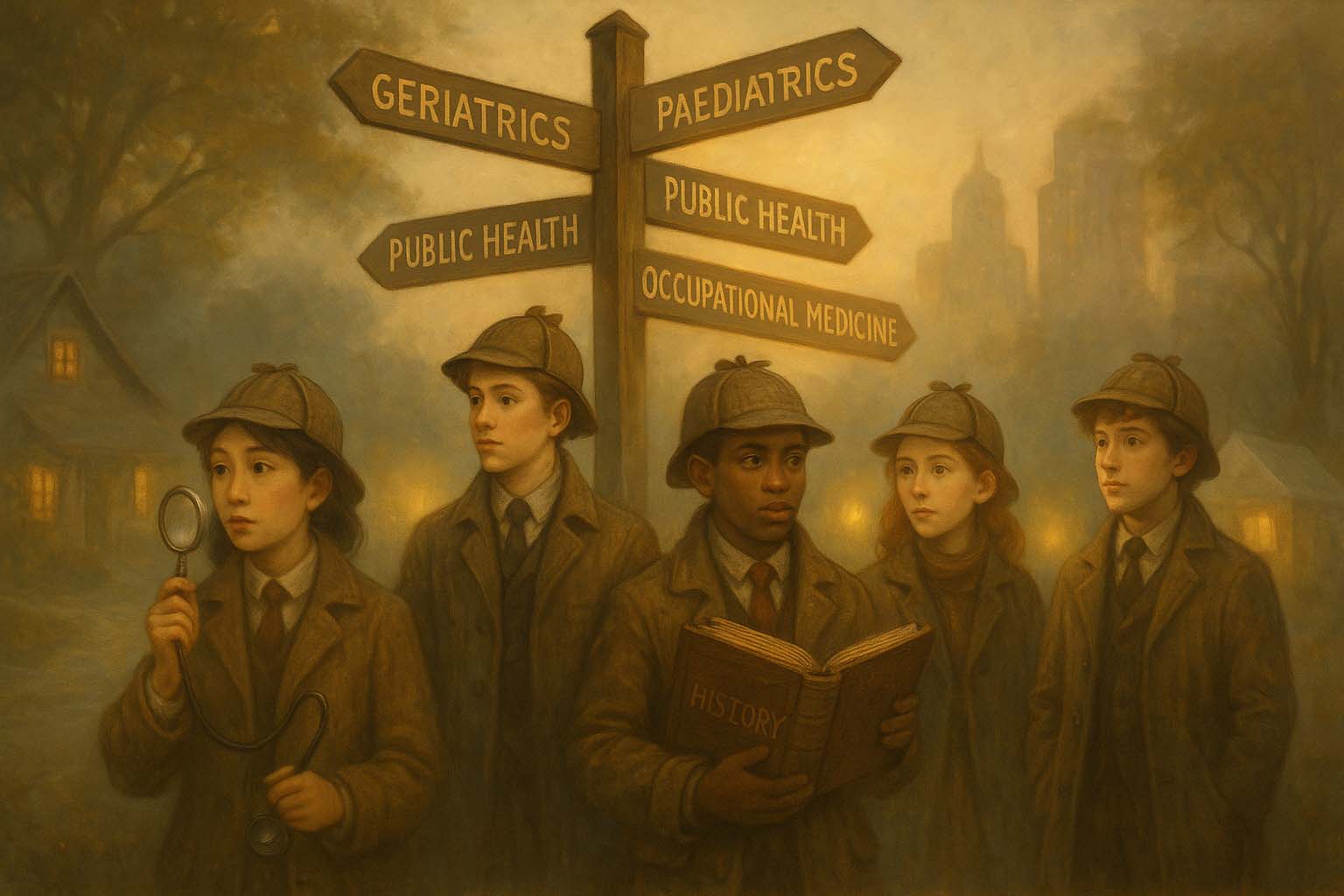
Step Into the Specialty Files: Explore Every Branch of Medicine - One Case at a Time
From broken bones to blurred vision, from hearts that race to minds in distress—discover how future doctors crack real clinical mysteries across every system.
Our Testimonials
Real med vibes.
It made me feel like a junior doctor before I even started.

Wow, just wow!
I actually enjoyed learning about diagnosis—it felt like a game, not a lecture.

Mind officially blown.
I never realised how much fun clinical reasoning could be.

Not just theory.
This helped me connect the dots between symptoms, science, and story.

Felt so ready.
Used one of the cases in my med school interview—they loved it!

So inspiring!
Medlock Holmes made me believe I could actually be a doctor one day.
