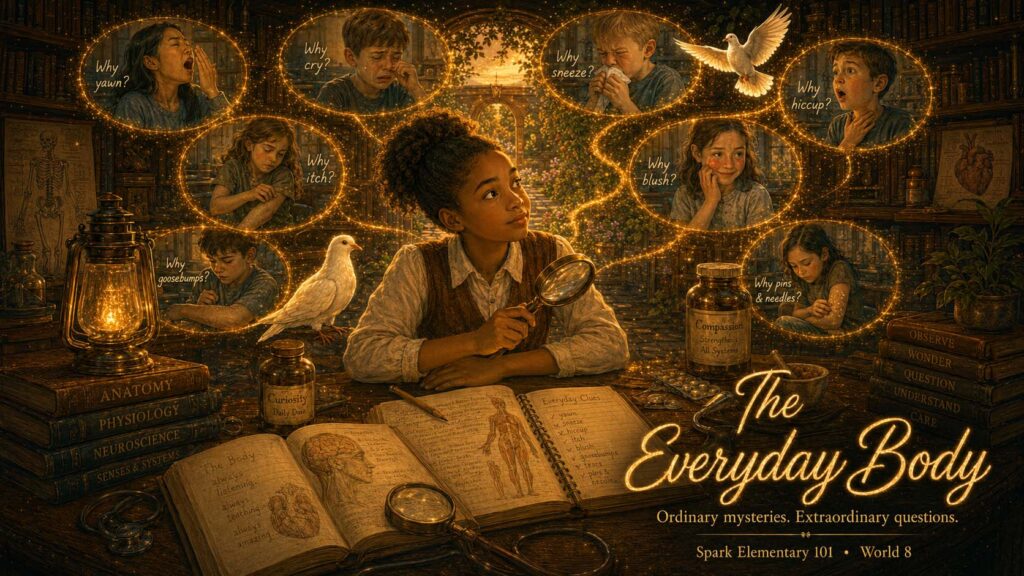
Someone yawns across the room.
A few seconds later, you yawn too.
Dust enters your nose and a sneeze erupts before you can stop it.
A hiccup interrupts your sentence.
Your face reddens when attention turns towards you.
Music raises goosebumps on your arms.
An itch demands to be scratched.
Your fingers wrinkle in the bath.
Your foot begins tingling after you sit on it for too long.
None of these moments seems important enough to belong in medicine.
Yet each one contains a clue about how the nervous system protects, communicates and reveals what is happening inside us.
Why does the body do so many small and peculiar things?
Enter the World
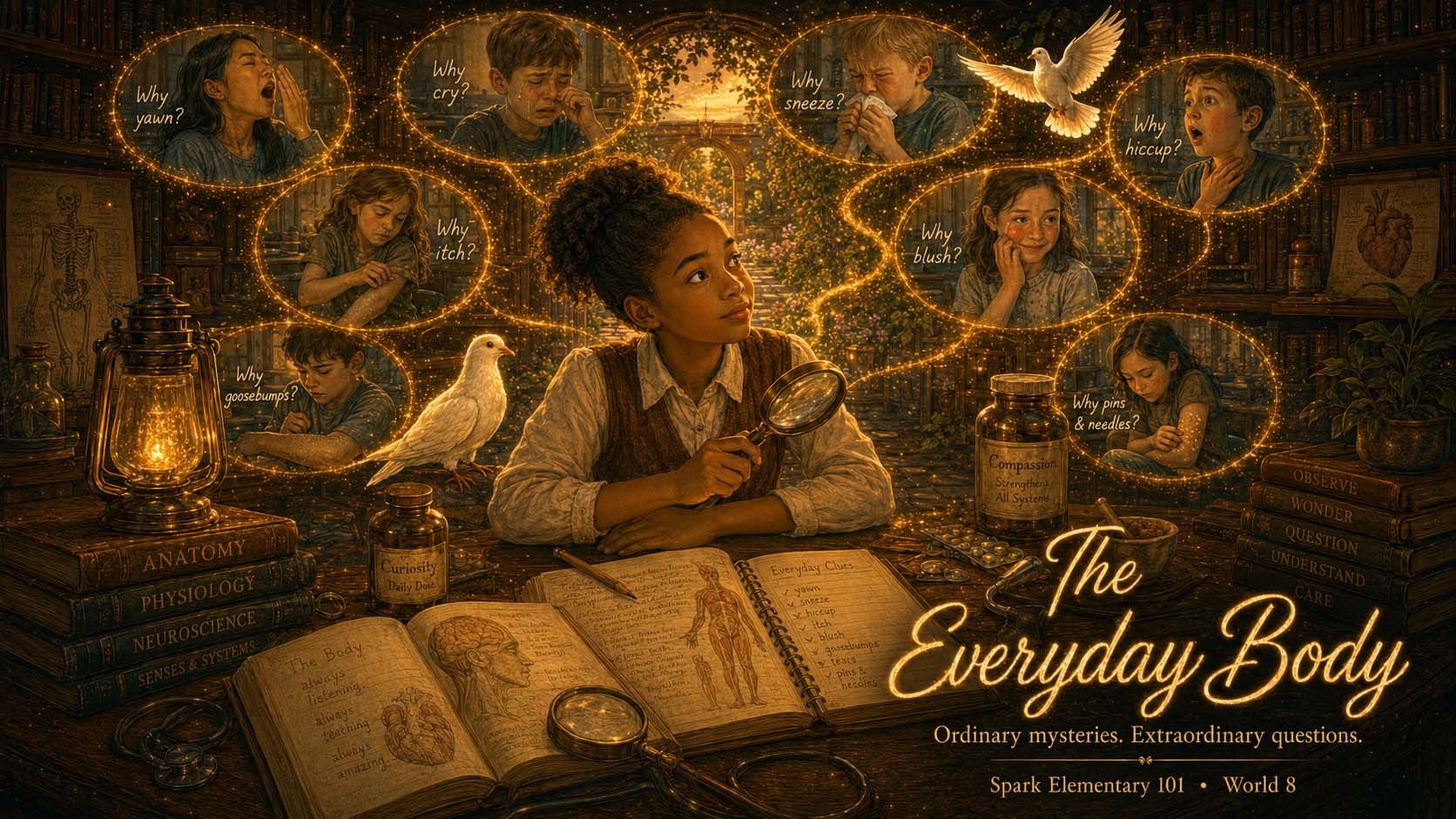
The Everyday Body explores ten familiar experiences that are easy to ignore but rich in biological meaning.
You will begin with actions that interrupt us without permission: yawning, sneezing and hiccupping.
You will then explore the body’s unspoken language through tears, blushing, goosebumps and butterflies in the stomach.
Finally, you will investigate tiny sensory mysteries: why an itch demands a scratch, why fingers wrinkle in water and why a numb foot returns with a storm of pins and needles.
Some of these phenomena are well understood.
Others remain partly mysterious.
Medicine can describe the nerves and muscles involved in a sneeze with great precision, yet still debate why yawning spreads from one person to another.
The Everyday Body therefore offers an important scientific lesson:
A good explanation must distinguish what we know from what we merely suspect.
Uncertainty is not the end of curiosity.
It is often where curiosity begins.
Three Paths Through the Everyday Body
Strange Reflexes
Some actions appear before we have decided to perform them.
A sneeze recruits the nose, throat, chest and breathing muscles in a rapid protective response.
A hiccup begins with an involuntary contraction of the diaphragm and ends with the sudden closure that creates its familiar sound.
A yawn may involve tiredness, changes in alertness and even the behaviour of people around us.
Why does the body contain these automatic programmes?
And why are some easier to explain than others?
Signals and Expressions
The body often speaks before words arrive.
Tears may protect the eye, respond to pain or express emotion.
The face may blush when we feel exposed.
Hair may rise during cold, fear, music or awe.
The stomach may flutter before an examination, performance or difficult conversation.
These reactions reveal that emotion does not live only inside the mind.
It travels through the whole body.
Tiny Mysteries
An itch is a small sensation with remarkable power.
It captures attention and produces an almost irresistible urge to scratch.
Water changes the shape of the fingertips.
Pressure on a nerve can temporarily silence sensation, only for feeling to return as tingling and tiny electric shocks.
These events may be brief, but they reveal the hidden work of sensory nerves, autonomic systems and protective responses.
Ten Questions to Follow
ELM-071
Why do we yawn?
Why do tiredness, boredom and changes in alertness produce a deep involuntary breath—and why can another person’s yawn trigger our own?
ELM-072
Why do we sneeze?
How does irritation inside the nose produce an explosive response involving the face, throat and breathing muscles?
ELM-073
Why do we hiccup?
Why does the diaphragm suddenly contract while the vocal cords snap shut?
ELM-074
Why do we cry?
Why does the eye produce tears for protection, irritation, pain and emotion?
ELM-075
Why do we blush?
Why can embarrassment or attention increase blood flow to the face without conscious permission?
ELM-076
Why do we get goosebumps?
Why do tiny muscles raise the hairs on our skin during cold, fear, music or awe?
ELM-077
Why do we get butterflies in our stomach?
How can anticipation, excitement or fear create a physical sensation deep inside the abdomen?
ELM-078
Why does an itch make us want to scratch?
Why does the skin create a sensation that demands one particular response?
ELM-079
Why do fingers wrinkle in water?
Why do fingertips change shape after being immersed while most of the skin remains relatively smooth?
ELM-080
Why do we get pins and needles?
Why does pressure on a nerve cause numbness followed by tingling, prickling and electric sensations?
The Body Can Act Before We Decide
We often imagine that movement begins with conscious choice.
But the nervous system contains automatic programmes designed to respond quickly.
A sneeze protects the airway.
A cough helps clear material from the throat and lungs.
A blink protects the surface of the eye.
A hand withdraws from heat.
These responses do not wait for a carefully considered decision.
Sensory nerves detect a possible threat.
Signals travel towards the brainstem or spinal cord.
A coordinated pattern of muscles is activated.
Only then may conscious awareness fully catch up.
The body is not ignoring us.
It is protecting us faster than deliberate thought could manage.
A Small Reflex May Involve the Whole Body
A sneeze may last only a moment.
Yet it requires a sequence involving:
sensory nerves in the nose
brainstem circuits
breathing muscles
the throat
the mouth
the face
and changing pressure inside the chest
A hiccup also appears simple.
But it depends upon a sudden contraction of the diaphragm followed by rapid closure of the glottis—the opening between the vocal cords.
That closure produces the characteristic sound.
These events remind us that a reflex is not always a single movement.
It may be a carefully timed performance involving several organs at once.
When hiccups persist for minutes, they are usually no more than an annoyance.
When they continue for days, they may become a medical clue.
The same familiar event can carry different meaning depending upon its duration, severity and context.
Not Every Mystery Has One Answer
Yawning was once commonly explained as the body’s attempt to obtain more oxygen.
That explanation is no longer considered sufficient.
Yawning often appears during transitions in alertness:
before sleep
after waking
during fatigue
during boredom
or when attention is changing
It may also spread socially from one person to another.
Researchers have proposed that yawning may help regulate alertness, synchronise groups or influence brain temperature.
No single theory explains every observation.
This makes yawning scientifically valuable.
It teaches that medicine is not a finished catalogue of facts.
Sometimes the honest answer is:
We understand parts of this, but not yet all of it.
That is not failure.
It is an invitation.
The Body Speaks Without Words
A person may say, “I am fine,” while their body tells a more complicated story.
Their face reddens.
Their hands tremble.
Their stomach tightens.
Their eyes fill with tears.
These reactions do not prove exactly what someone is feeling.
But they reveal that emotion is embodied.
The brain communicates with:
the heart
blood vessels
skin
gut
breathing
muscles
and glands
The body may therefore express a response before a person has found words for it.
Medicine must notice these signals without assuming that it already knows their meaning.
Blushing might accompany embarrassment, anxiety, anger, warmth or a skin condition.
Tears might reflect grief, relief, pain, joy, irritation or exhaustion.
The body offers clues.
The person provides the story.
Tears Have More Than One Purpose
The eyes produce different kinds of tears.
Basal tears continually lubricate and protect the eye.
Reflex tears respond to irritation such as smoke, dust or onion vapour.
Emotional tears accompany experiences such as grief, joy, frustration, relief or connection.
The biological purpose of emotional crying is not fully settled.
It may help regulate intense states.
It may communicate vulnerability or a need for support.
It may draw other people closer when language is insufficient.
A tear can therefore be both fluid and message.
Medicine must never treat crying as weakness.
Sometimes it is the body’s way of saying that an experience has exceeded what words can currently hold.
Blushing Reveals Our Social Nature
Blushing occurs when small blood vessels in the face widen, increasing blood flow near the skin.
The response is controlled largely by the autonomic nervous system—the part of the nervous system that regulates many bodily processes without direct conscious control.
A person cannot simply order themselves not to blush.
Trying to suppress it may even increase the sense of self-consciousness.
Blushing is particularly interesting because it often appears when we become aware of how others may see us.
It is biology responding to relationship.
Our bodies do not exist in isolation.
They respond not only to temperature, infection and injury, but also to attention, belonging, judgement and connection.
Goosebumps Are Echoes of an Earlier Body
Each hair follicle is attached to a tiny muscle.
When these muscles contract, the hairs rise and the skin develops its familiar bumpy appearance.
In furry animals, raised hair may trap insulating air or make the animal appear larger when threatened.
Humans possess much less body hair, so the original effects are limited.
Yet the response remains.
Cold may trigger it.
Fear may trigger it.
Music, awe or emotional intensity may trigger it.
Goosebumps are therefore a small reminder that the human body carries traces of its evolutionary past.
Some features remain because they are still useful.
Others may persist as echoes of systems that served our ancestors more powerfully.
Emotion Reaches the Gut
Before an examination, performance or important conversation, the abdomen may feel light, tight or unsettled.
These “butterflies” arise because the brain and digestive system are in constant communication.
The autonomic nervous system changes:
gut movement
blood flow
muscle tension
digestive activity
and awareness of internal sensations
Adrenaline and other stress signals prepare the body for action.
Resources may temporarily shift away from digestion.
Ordinary sensations from the gut may become more noticeable.
This does not mean the experience is “all in the mind”.
It means that mind and body were never separate systems to begin with.
The gut can influence emotion.
Emotion can influence the gut.
Medicine must understand the conversation in both directions.
An Itch Is a Command Disguised as a Sensation
An itch does more than report that something has happened.
It creates an urge to act.
Specialised sensory pathways carry signals from the skin towards the spinal cord and brain.
The sensation captures attention and motivates scratching.
In the short term, scratching may reduce itch because pain and touch signals briefly interfere with the itch pathway.
But scratching can also damage the skin, increase inflammation and create more itching.
This can produce an itch–scratch cycle:
itch
scratch
temporary relief
skin injury
greater inflammation
more itch
An itch may arise from an insect bite or dry skin.
Persistent itch can also accompany eczema, allergy, liver disease, kidney disease, medication effects or problems in the nervous system.
A tiny sensation may therefore open a much larger clinical investigation.
Wrinkled Fingers Are Not Simply Waterlogged
Fingers and toes become wrinkled after prolonged immersion in water.
This was once assumed to happen because the skin simply absorbed water and swelled unevenly.
Water does affect the outer skin, but the patterned wrinkling of fingertips also depends upon active narrowing of blood vessels controlled by autonomic nerves.
When these nerves are damaged, normal wrinkling may be reduced.
Why does this response exist?
One possibility is that the grooves improve grip on wet objects, rather like channels in a tyre.
The idea is plausible, although the full evolutionary explanation remains debated.
Wrinkled fingers therefore reveal two important lessons:
A familiar physical change may be actively controlled by the nervous system.
And a reasonable scientific theory is not the same as a proven conclusion.
Pins and Needles Reveal the Return of a Signal
Sitting awkwardly may place pressure on a nerve.
The limb feels numb or heavy.
When the position changes, sensation returns as tingling, prickling or tiny electric shocks.
Pressure can temporarily disturb a nerve’s ability to transmit signals. It may also affect the small blood vessels supplying that nerve.
As the pressure is released, different nerve fibres recover at different speeds.
The returning, disorganised signals are experienced as pins and needles.
Usually, this passes quickly.
Persistent numbness or tingling may point towards:
ongoing nerve compression
diabetes
vitamin deficiency
circulatory problems
medication effects
or neurological illness
Medicine often begins by asking about time.
Did the sensation last seconds?
Minutes?
Days?
Did it follow an awkward position?
Does it keep returning?
A fleeting inconvenience and an important symptom may feel similar at first.
Their stories distinguish them.
The Ordinary Body Is Never Really Ordinary
The Everyday Body reveals that many small events are signs of active systems.
A sneeze is protection.
A blush is autonomic communication.
Butterflies are brain–gut dialogue.
An itch directs attention.
Finger wrinkling reveals nerve control.
Pins and needles expose a temporary interruption in signalling.
These moments occur so often that they become invisible.
But medicine depends upon the ability to see what familiarity has hidden.
Curiosity begins when the ordinary becomes strange again.
The person who asks why a yawn spreads across a classroom is practising the same habit of mind as the scientist investigating an unsolved problem.
The scale is different.
The act of noticing is the same.
Small Symptoms Can Become Large Experiences
Yawning, itching, tingling and hiccupping are usually brief.
But imagine:
hiccups that continue for weeks
itching that prevents sleep every night
blushing that makes someone avoid school or work
persistent tingling that affects walking
tears that arrive without an understood emotional cause
ordinary bodily experiences can become intrusive, painful or disabling.
Medicine must not dismiss a symptom simply because everyone experiences a milder version of it.
The important question is not merely:
Is this common?
It is:
What is this experience doing to this person’s life?
The Calling Question
You have followed a yawn across a room, a sneeze through the airway and a hiccup from the diaphragm to the voice.
You have watched emotion appear through tears, skin, hair and the stomach.
You have seen an itch become an instruction, water reveal autonomic nerves and pressure briefly interrupt sensation.
What draws you closer?
Is it the precision of reflexes?
The relationship between body and emotion?
The traces of evolution hidden in the skin?
The fact that medicine still cannot explain everything?
The possibility that a tiny symptom may reveal a larger problem?
Or simply the joy of discovering that the familiar world is stranger than it first appears?
Do ordinary experiences make me stop and ask extraordinary questions?
Pause for a moment.
Notice whether you are now paying closer attention to the small things your body does.
Begin World Eight
Start with ELM-071: Why do we yawn?
Someone nearby may already have started the experiment.
Now follow the mystery.