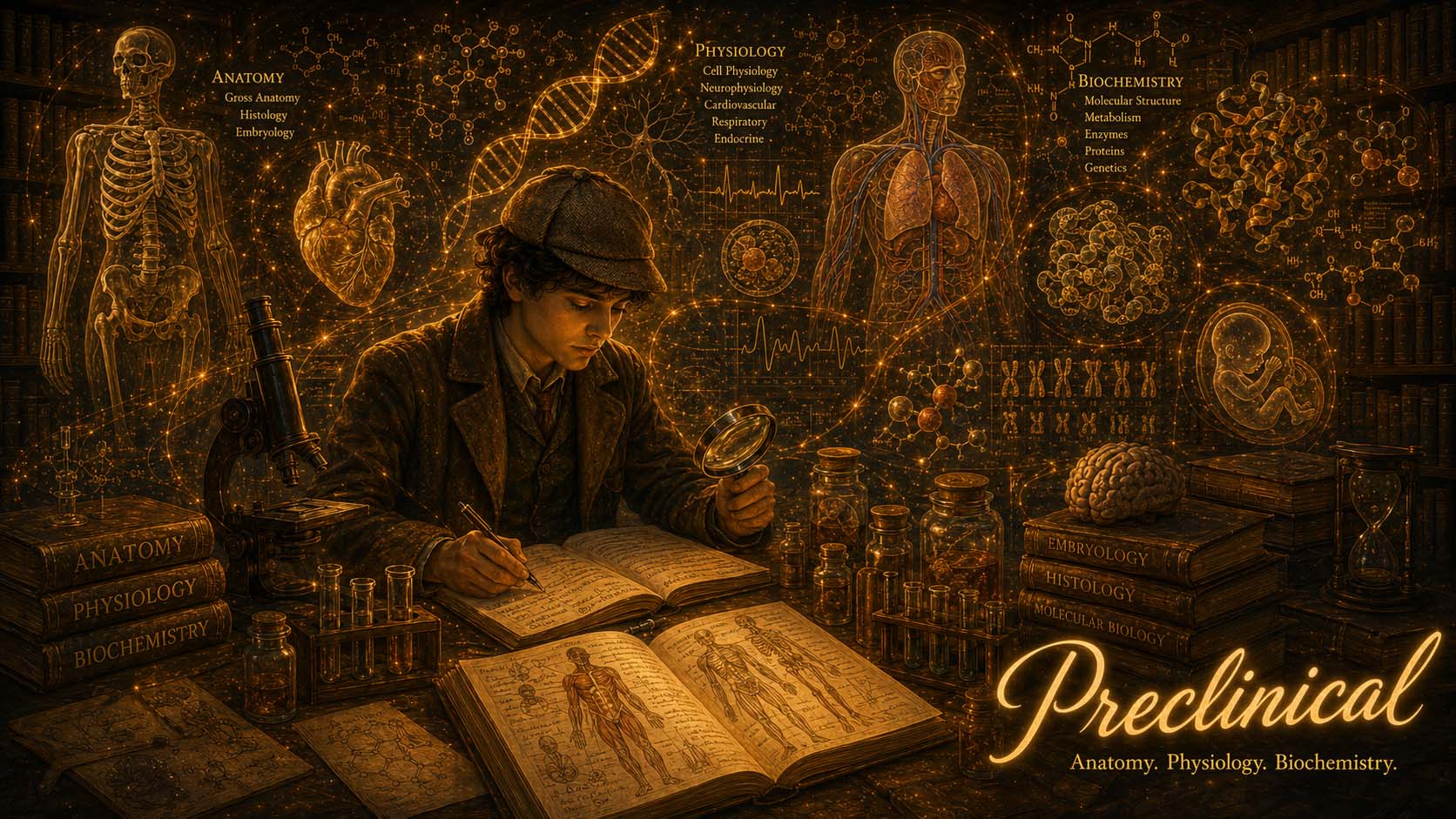
How is the human body constructed?
How do its organs, tissues and cells work?
How does the body transform matter into energy, maintain balance and communicate across complex biological systems?
And how does a single fertilised cell become a human being?
Preclinical Sciences explores the foundations upon which the rest of medicine is built.
Through Clinical Deep Dives in Anatomy, Physiology, Biochemistry and Embryology, learners are guided beneath the surface of the subject -beyond lists of facts and towards the structures, mechanisms and relationships that make the human body intelligible.
The Sciences Before Disease
The preclinical sciences introduce the healthy body before disease alters it.
They provide the basic language through which medicine is later understood:
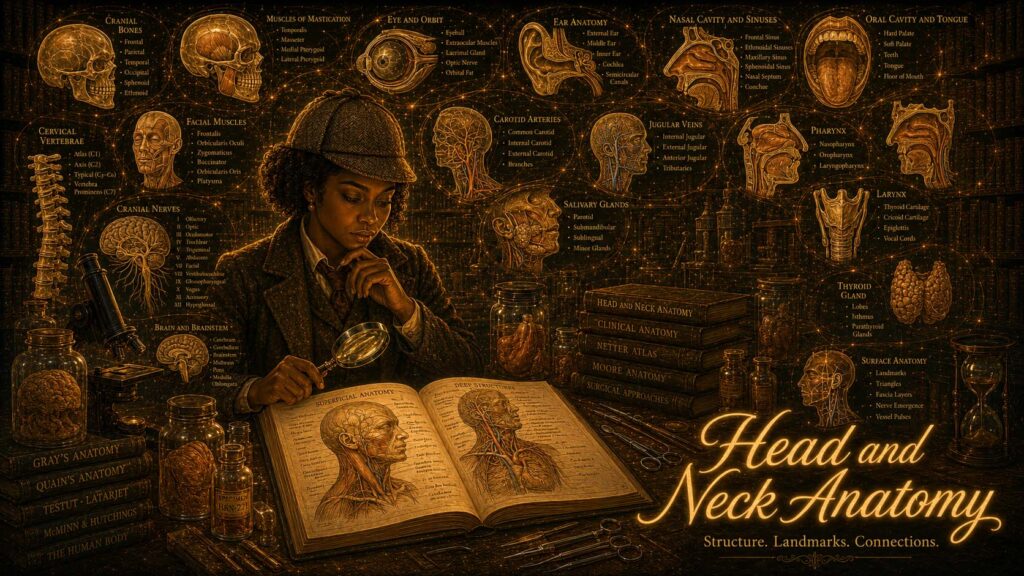
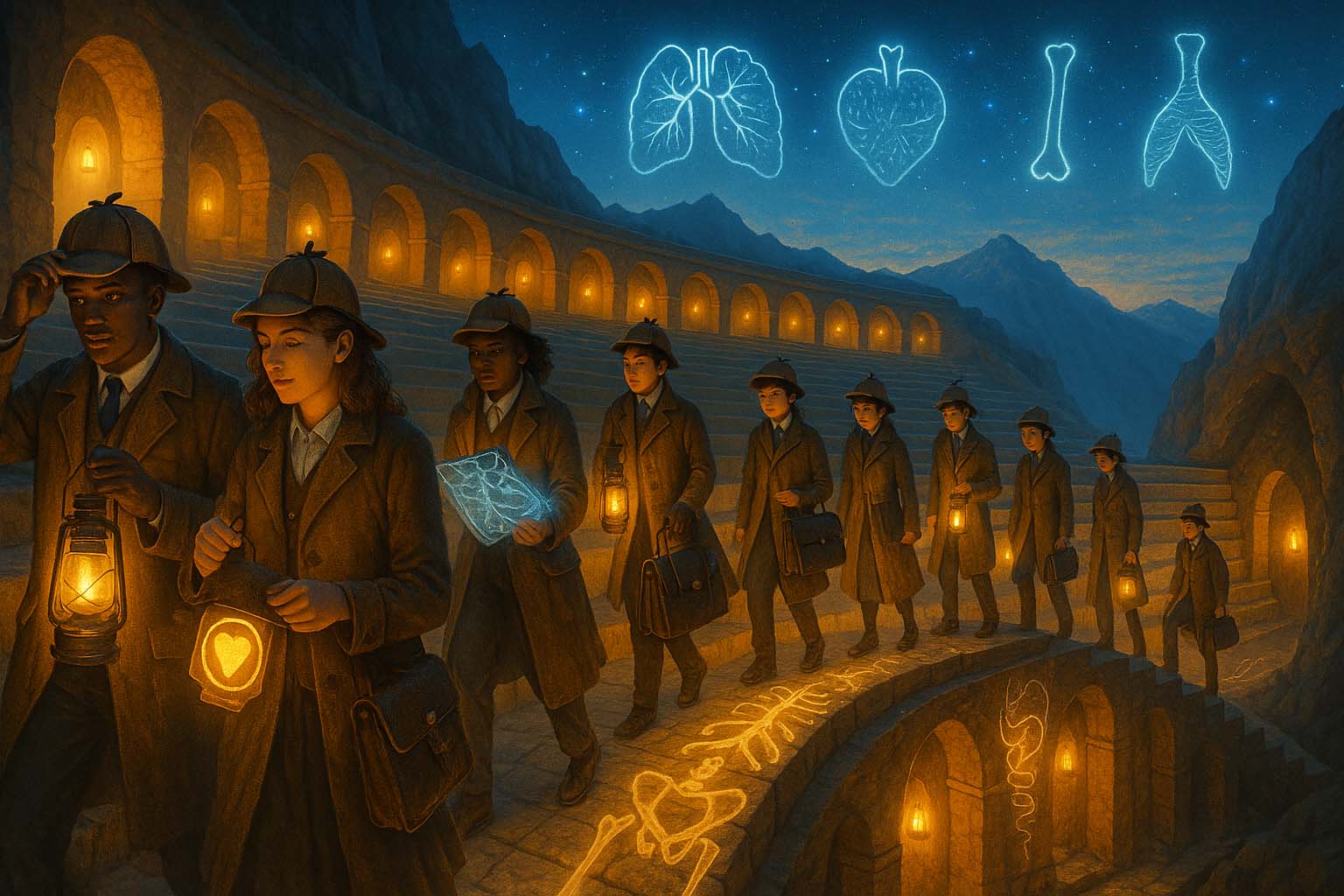
Anatomy reveals the structure.
Physiology explains the function.
Biochemistry uncovers the molecular processes.
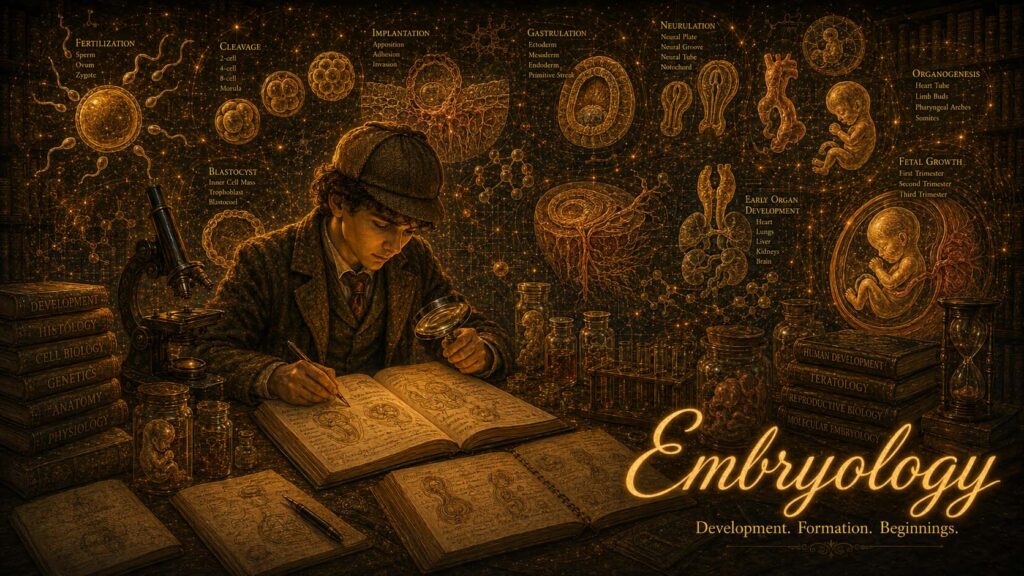
Embryology tells the story of how it all came to be.
These disciplines are often taught separately, divided into lectures, chapters and examination topics. Yet the body itself does not recognise those boundaries.
Every structure exists to perform a function.
Every function depends upon molecular processes.
Every adult organ carries within it the history of its development.
Preclinical Sciences brings these perspectives together so that learners can begin to see the body not as a collection of disconnected facts, but as a coherent living system.
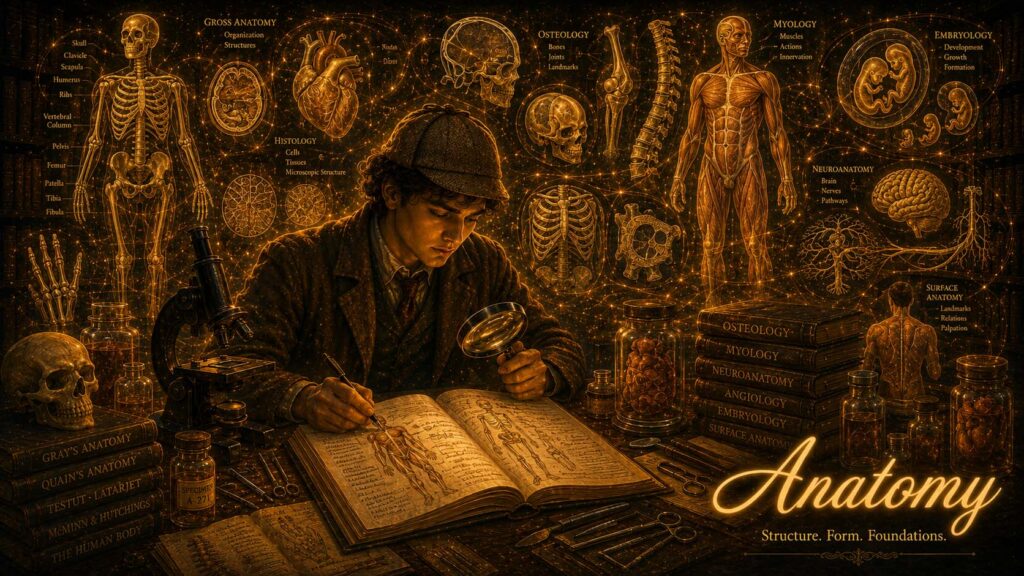
ANATOMY
Learning the landscape of the human body.
Anatomy is often described as the language of medicine.
It provides the names, relationships and spatial understanding that allow clinicians to describe where something is, what lies beside it and what may be affected when injury or disease occurs.
Yet anatomy is much more than the memorisation of muscles, nerves, vessels and foramina.
It is the study of biological design.
Why does a nerve follow a particular route?
Why are some structures vulnerable to compression or injury?
How does the shape of a joint permit one movement while restricting another?
Why does disease spread along certain anatomical planes?
The Anatomy Clinical Deep Dives help learners move from naming structures to understanding their relationships and significance.
Topics may include:
- regional and gross anatomy
- neuroanatomy
- osteology
- surface anatomy
- functional anatomy
- radiological anatomy
- histology
- clinically applied anatomy
The aim is not merely to know what a structure is called.
It is to understand where it belongs, what it connects to and why it matters.
Explore Anatomy Clinical Deep Dives →
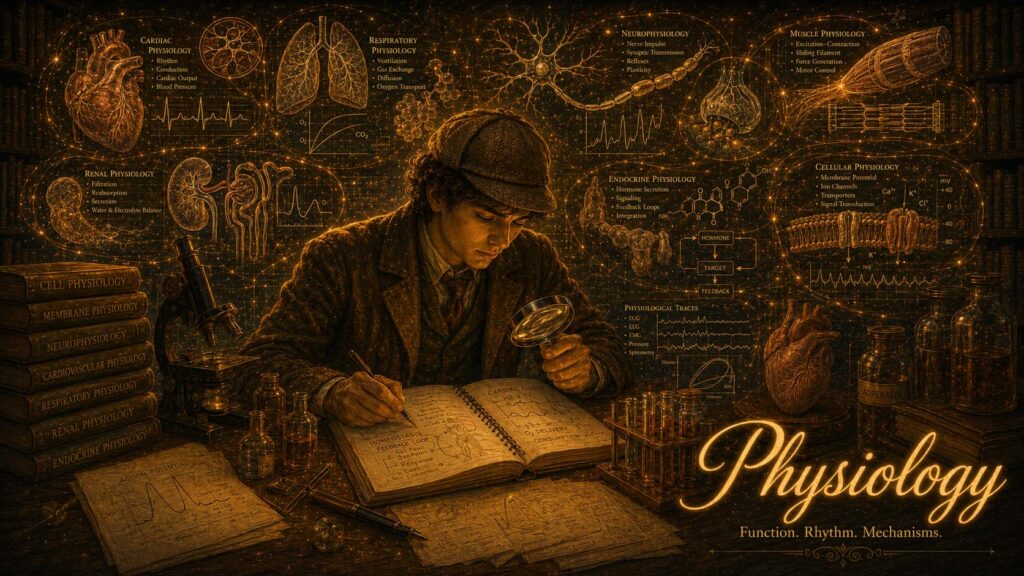
PHYSIOLOGY
Understanding the body in motion.
If anatomy provides the map, physiology reveals what is happening within it.
Physiology explores how cells, tissues and organs communicate, adapt and work together to sustain life.
It asks how the heart generates pressure, how the lungs exchange gases, how the kidneys regulate fluid, how nerves transmit signals and how the body maintains stability despite constant internal and external change.
These processes can easily become buried beneath equations, pathways and unfamiliar terminology.
The Physiology Clinical Deep Dives draw those elements together into understandable mechanisms.
Rather than presenting isolated facts, they follow the sequence of events:
What changes first?
What detects the change?
How does the body respond?
Which feedback loops restore balance?
What happens when compensation is no longer sufficient?
Topics may include:
- cellular physiology
- cardiovascular physiology
- respiratory physiology
- renal physiology
- gastrointestinal physiology
- endocrine physiology
- reproductive physiology
- neurophysiology
- homeostasis
- fluid, electrolyte and acid–base balance
Physiology transforms the body from a static diagram into a living conversation.
Explore Physiology Clinical Deep Dives →
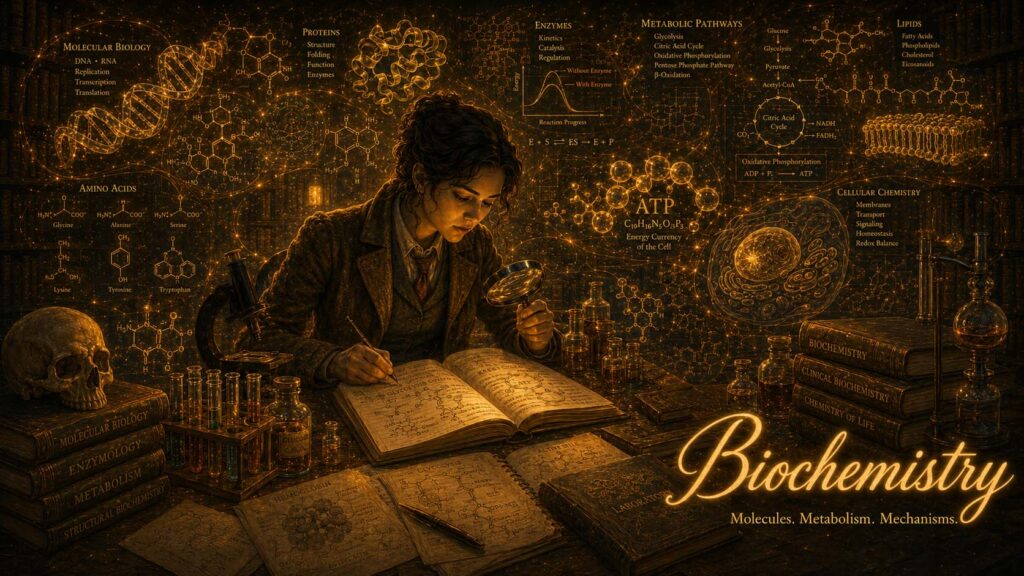
BIOCHEMISTRY
Discovering the molecular machinery of life.
Biochemistry takes us beneath organs and tissues into the molecular processes that make life possible.
It explains how nutrients become energy, how proteins are built, how enzymes accelerate reactions, how DNA carries information and how cells regulate thousands of chemical processes without descending into chaos.
For many learners, biochemistry can initially feel like an unfamiliar maze of pathways, abbreviations and molecular structures.
The Clinical Deep Dives are designed to reveal the logic within that maze.
Metabolic pathways are not presented merely as sequences to be memorised. They are explored as purposeful systems:
What is the cell trying to achieve?
What material enters the pathway?
What is produced?
Where is energy consumed or released?
How is the process regulated?
Why does the pathway change during feeding, fasting, exercise or illness?
Topics may include:
- proteins and amino acids
- carbohydrates and lipids
- enzymes and cellular reactions
- energy metabolism
- vitamins and cofactors
- molecular biology
- DNA, RNA and protein synthesis
- cellular signalling
- genetics and gene expression
- metabolic integration
Biochemistry allows us to see that the body is not only an anatomical structure or physiological machine.
It is also a vast, regulated chemistry of life.
Explore Biochemistry Clinical Deep Dives →
EMBRYOLOGY
Understanding how the body becomes itself.
Embryology tells one of the most remarkable stories in medicine.
It begins with a single cell and follows the sequence through which tissues differentiate, organs form and the basic architecture of the human body emerges.
Many features of adult anatomy are difficult to understand until their developmental origins are known.
Why do certain nerves take apparently indirect routes?
Why do some organs migrate from one region to another?
Why do congenital abnormalities occur in recognisable patterns?
Why can developmental remnants remain visible or become clinically important many years later?
Embryology provides the hidden narrative beneath adult structure.
The Embryology Clinical Deep Dives guide learners through development as a sequence of transformations rather than a list of stages to be memorised.
Topics may include:
- fertilisation and implantation
- formation of the germ layers
- folding of the embryo
- placental development
- development of the nervous system
- formation of the heart and circulation
- development of the gastrointestinal and urogenital systems
- craniofacial development
- limb development
- congenital abnormalities and developmental disruption
Embryology reminds us that anatomy is not simply assembled.
It unfolds.
Explore Embryology Clinical Deep Dives →
Four Lenses, One Human Body
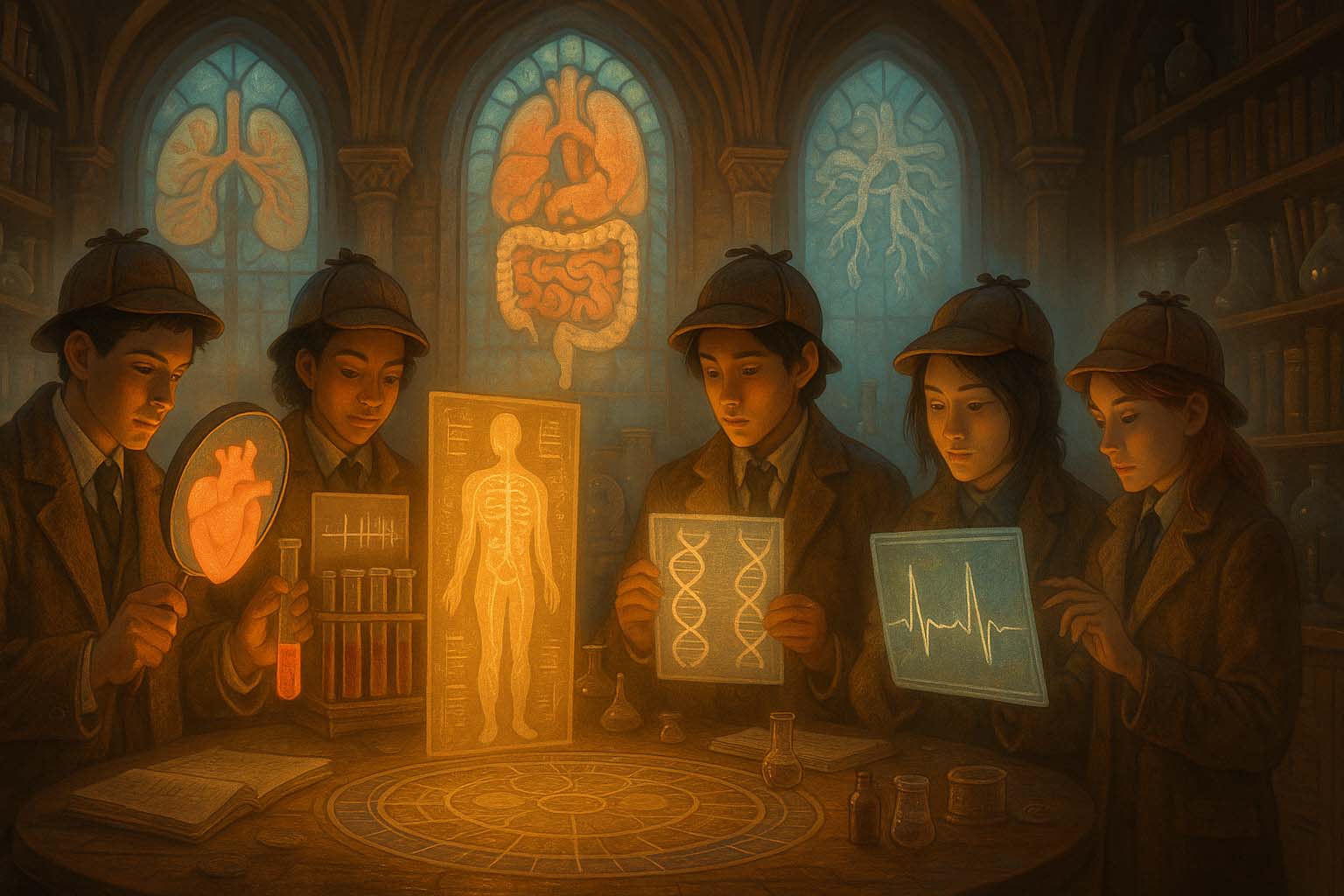
The four preclinical disciplines offer different ways of looking at the same biological reality.
Consider the heart.
Anatomy shows its chambers, valves, vessels and relationships within the thorax.
Physiology explains how it generates pressure and circulates blood.
Biochemistry reveals how cardiac cells produce energy and regulate contraction.
Embryology traces how the primitive heart tube folds, divides and becomes a four-chambered organ.
Each discipline adds something essential.
Studied separately, they provide information.
Brought together, they provide understanding.
This integration prepares learners for the next stage of medicine, where normal structure and function must be compared with the changes created by disease.
Clinical Deep Dives
Conceptual companions for difficult subjects.
The Preclinical Clinical Deep Dives are designed to accompany, rather than replace, lectures, textbooks and formal courses.
They draw upon major source texts and bring together ideas that may be distributed across many chapters or presented differently by different authors.
Each Deep Dive seeks to uncover the conceptual backbone of the topic.
You may encounter:
- complex mechanisms explained in logical stages
- memorable metaphors and analogies
- links between structure and function
- distinctions between commonly confused concepts
- clinical examples that reveal why the science matters
- memory aids for dense terminology
- recurring frameworks that organise large subjects
- connections between material taught in different disciplines
The purpose is not to make medicine artificially simple.
It is to make complexity navigable.
From Textbook Chapter to Mental Model
A textbook often gives the learner all the pieces.
The greater challenge is discovering how they fit together.
The Clinical Deep Dives help learners construct a mental model before adding finer detail.
That model becomes a kind of intellectual skeleton.
New facts can attach to it.
Mechanisms can be traced through it.
Clinical knowledge can later grow around it.
Without such a framework, information may be remembered briefly but remain fragmented.
With it, learning becomes cumulative.
One concept strengthens another.
One subject illuminates the next.
Designed for Flexible Learning
The Preclinical Sciences library can be used at different stages and in different ways.
Before a lecture
Gain an overview of the subject and identify the organising ideas before encountering the detail.
Alongside a textbook
Use the Deep Dive as a conceptual companion while reading a major chapter or section.
After formal teaching
Consolidate the mechanism and reconnect material that may have been presented across several lectures.
During revision
Return to the central model before revisiting finer facts, diagrams and examination questions.
Later in clinical practice
Revisit the foundational science that explains a symptom, investigation or treatment.
The same material may reveal something different each time it is encountered.
A first-year learner may hear the mechanism.
A clinical learner may hear the diagnosis within it.
A Growing Library
Preclinical Sciences is not a completed shelf.
It is a living library.
The current collection includes substantial sequences in:
- Anatomy
- Physiology
- Biochemistry
- Embryology
Over time, these foundations will be expanded through further conceptual guides, including more detailed explorations of:
- neuroanatomy
- histology
- cellular biology
- molecular biology
- genetics
- radiological anatomy
- functional anatomy
- integrated organ science
- other foundational disciplines
New Deep Dives will continue to be added as the Medlock Holmes learning ecosystem grows.
Each addition will follow the same purpose:
To clarify what is difficult.
To connect what has been separated.
To make the foundations of medicine easier to revisit and harder to forget.
Listen Wherever You Learn
The Preclinical Sciences Clinical Deep Dives are available through:
- Substack
- Spotify
- Apple Podcasts
- other major podcast platforms
Use the subject collections below to enter the library.
Choose Your Subject
ANATOMY
Explore the structures, relationships and spatial logic of the human body.
Enter Anatomy →
PHYSIOLOGY
Explore the mechanisms through which the living body maintains function and balance.
Enter Physiology →
BIOCHEMISTRY
Explore the molecular pathways and cellular processes that sustain life.
Enter Biochemistry →
EMBRYOLOGY
Explore the developmental journey through which the human body takes form.
Enter Embryology →
From Foundations to Disease
Preclinical Sciences asks:
How is the healthy body built?
How does it work?
How did it develop?
The next school asks what happens when these structures and processes are disrupted.
In Paraclinical Sciences, normal biology meets pathology, microorganisms, medicines, population health and the investigation of injury and death.
The foundation has been laid.
The next task is to understand how it changes.
Continue to Paraclinical Sciences →
Understand the Body Before You Interpret Its Distress
Clinical medicine begins when someone presents with pain, weakness, fever, breathlessness, confusion or fear.
But beneath every symptom lies a structure, a physiological process, a biochemical pathway or a developmental history.
The preclinical sciences teach us to see those foundations.
To understand what was there before disease arrived.
To recognise what has changed.
And eventually, to reason our way towards why.
Medlock Holmes Preclinical Sciences
Learn the structure. Follow the function. Discover the origins.