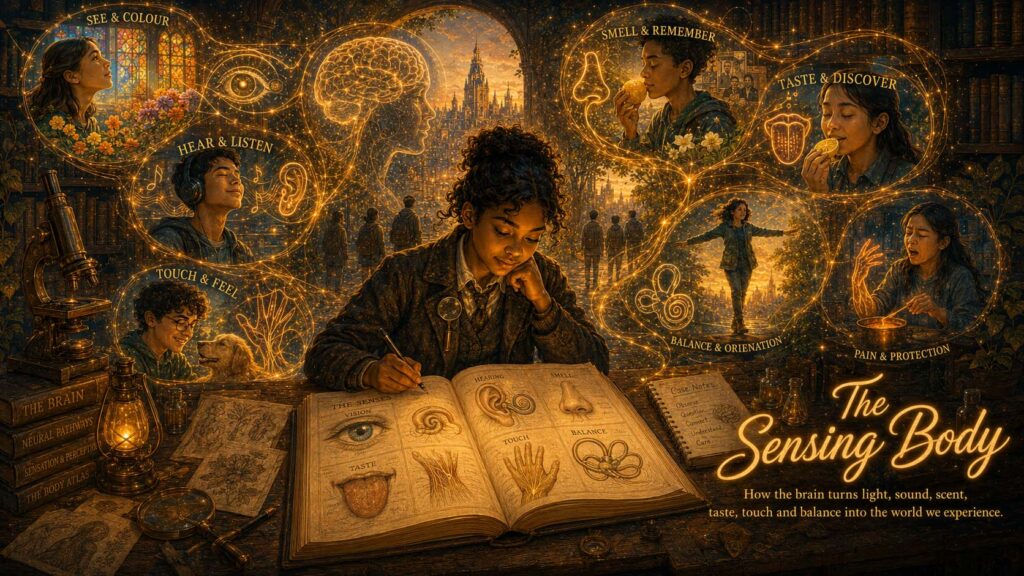
Open your eyes.
Light enters—and becomes colour, shape, distance and movement.
Listen.
Vibrations travelling through the air become a voice, a melody or a warning.
Breathe in.
Invisible molecules become the smell of rain, smoke, food or home.
Place your hand against a surface.
Pressure becomes texture. Temperature becomes warmth. Injury becomes pain.
Yet your brain never touches the outside world directly.
It receives only signals.
How does the body turn those signals into reality?
Enter the World
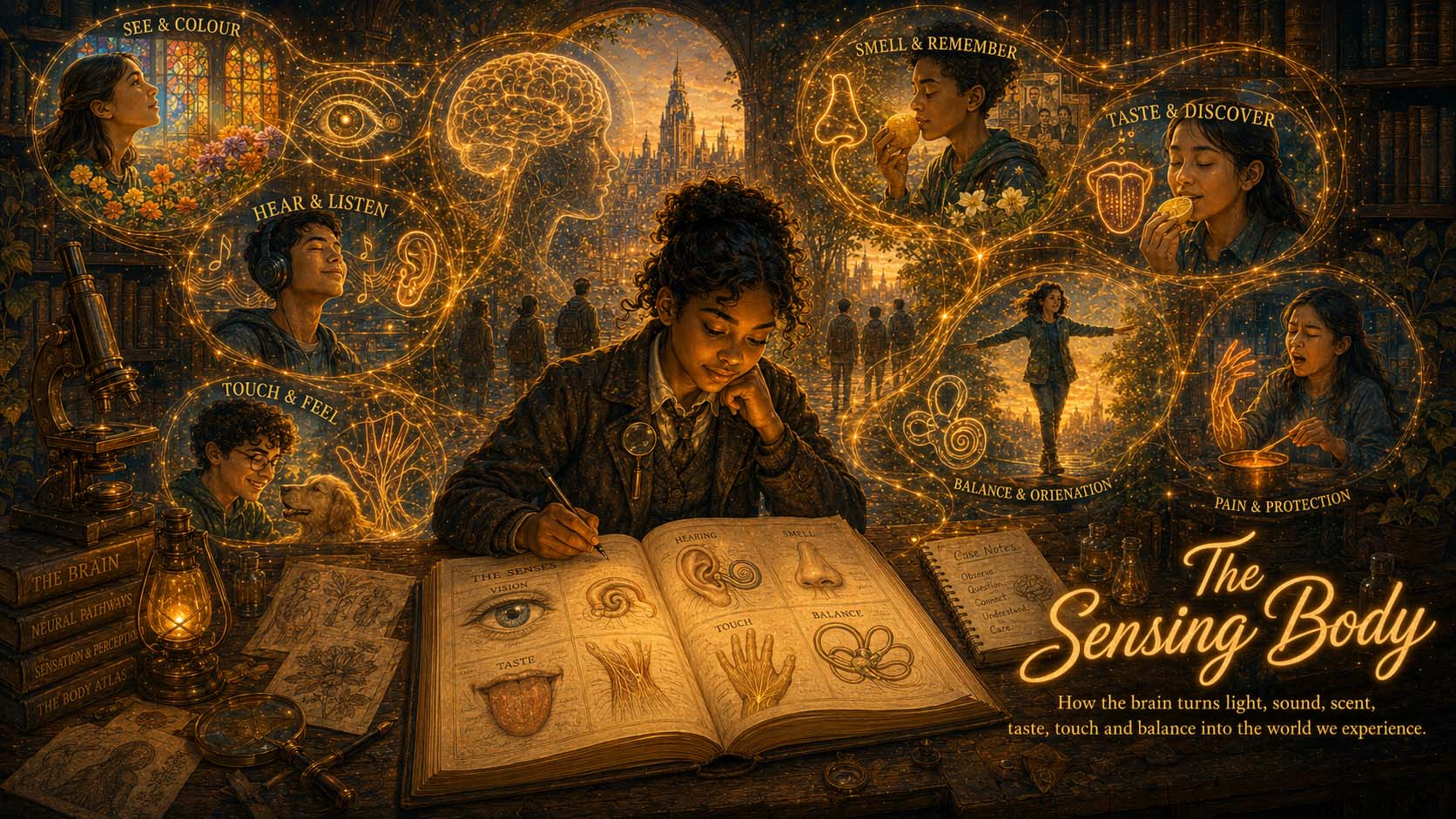
The Sensing Body explores how the world outside us becomes an experience within us.
You will begin with light entering the eye and discover how the brain transforms it into the rich visual world we call sight.
You will follow vibrations through the ear until they become speech and music.
You will explore why a forgotten memory can return through a smell, why food loses much of its flavour when the nose is blocked and why some parts of the body are more sensitive than others.
Finally, you will investigate balance, dizziness and pain—sensations that help the brain answer two essential questions:
Where am I?
Am I safe?
This is not simply a World about eyes, ears, noses and skin.
It is about how the brain continually interprets the clues arriving from the body and the world.
Four Paths Through the Sensing Body
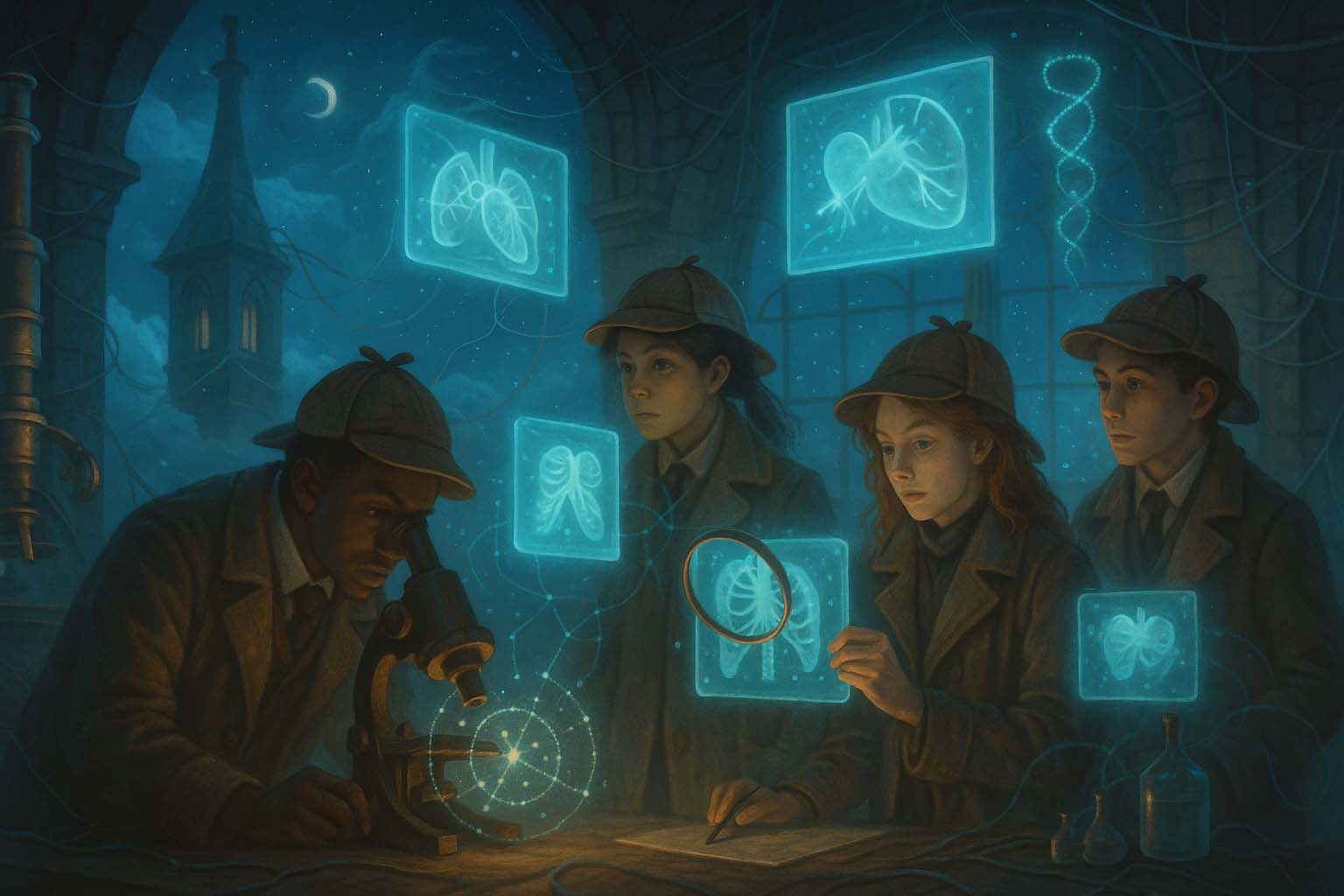
Seeing
The eye receives light.
But light alone contains no recognisable faces, distant landscapes or written words.
How does the eye focus light? Where does colour come from? And why does a room that first appears completely dark gradually become visible?
The eye begins vision.
The brain creates seeing.
Hearing
Sound begins as movement.
A vibrating string, vocal cord or loudspeaker creates waves in the air. The ear must capture those vibrations, separate their frequencies and convert them into signals the brain can understand.
How does movement become speech?
And why can a melody produce emotion, tension or goosebumps throughout the body?
Smell and Taste
A scent can return us to another time before we have consciously identified it.
The smell of a particular spice, perfume or place may awaken a person, memory or emotion that seemed to have disappeared.
Why is smell so closely connected with memory?
And why does food lose much of its flavour when the nose is blocked?
Touch, Balance and Pain
The skin detects pressure, vibration and temperature.
The eyes, inner ears and body-position senses help us remain upright and know where we are in space.
The nervous system also creates pain—an unpleasant but protective experience that demands attention.
Why are fingertips more sensitive than the back?
Why do we become dizzy when our senses disagree?
And why can pain continue even after an injury has healed?
Ten Questions to Follow
ELM-031
How do our eyes turn light into sight?
How does light entering the eye become shape, movement, distance, recognition and meaning?
ELM-032
Why do we see colour?
Is redness really inside a strawberry—or is colour something the brain creates from different wavelengths of light?
ELM-033
Why do our eyes adjust to darkness?
Why does a dark room gradually become visible after initially appearing completely black?
ELM-034
How do our ears turn vibrations into sound?
How does invisible movement in the air become a voice, a word or a piece of music?
ELM-035
Why do some sounds make us shiver?
Why can music, a whisper or a sudden noise produce goosebumps, emotion or bodily tension?
ELM-036
Why are smell and memory so closely connected?
How can a scent suddenly return us to a person, place or moment we had almost forgotten?
ELM-037
Why does food taste bland when our nose is blocked?
Why is flavour created by far more than the taste buds on the tongue?
ELM-038
Why is touch more sensitive in some parts of the body?
Why can fingertips detect tiny details that the forearm or back cannot?
ELM-039
Why do we become dizzy?
What happens when the eyes, inner ears and body-position senses no longer agree about where we are?
ELM-040
Why does pain hurt?
Why does the nervous system create suffering—and why can pain sometimes continue after tissues have healed?
The Brain Builds the Experience
The eyes do not contain pictures.
The ears do not contain sound.
The tongue does not contain flavour.
The skin does not contain pain.
Sensory organs detect physical and chemical events and convert them into patterns of nerve activity.
The brain must then interpret those patterns using:
context
attention
memory
expectation
emotion
previous experience
The same signal can therefore create different experiences.
A loud sound at a concert may feel exhilarating.
A similar sound heard unexpectedly in a dark house may feel threatening.
Cool water may feel cold after warmth but surprisingly warm after ice.
A familiar smell may be pleasant to one person and deeply unsettling to another.
The Sensing Body reveals that perception is not simply received.
It is constructed.
More Than Five Senses
We often speak of five senses.
But the body detects much more than sight, hearing, smell, taste and touch.
It also senses:
temperature
pain
balance
movement
the position of our limbs
the stretching of internal organs
hunger, thirst and breathlessness
Without looking, you usually know whether your hand is raised or resting by your side.
You can remain upright while walking, turn towards a voice and withdraw from a hot surface before fully understanding what has happened.
The sensory world extends both outside and within us.
When the World Changes
Sensory loss is not simply the failure of an organ.
When sight changes, a person’s independence may change.
When hearing fades, conversation may become exhausting and isolation may grow.
When smell disappears, food, memory and the detection of danger may all be affected.
When balance becomes unreliable, the world itself may seem to move.
When pain persists, attention, sleep, mood, movement and identity can all become entangled with it.
Medicine therefore does not care only for eyes, ears, nerves or skin.
It cares for a person’s access to the world.
The task is not simply to ask:
Which sense has changed?
It is also to ask:
What has this change taken from the person—and what might help them regain it?
Pain Is Real, Even When It Is Complex
Pain often begins with signals associated with injury or threat.
But pain is not a direct measurement of tissue damage.
Its intensity may also be shaped by fear, attention, memory, sleep, mood, inflammation, previous experience and whether the nervous system believes the body is safe.
A serious injury may initially cause surprisingly little pain during an emergency.
A small injury in a sensitive area may feel overwhelming.
Pain may sometimes continue after tissues have healed because the nervous system remains protective.
This does not make the pain imaginary.
It means pain is a complex human experience—not a simple reading from the damaged tissue.
One of medicine’s most compassionate lessons begins here:
Pain is always real to the person experiencing it, even when its cause cannot be seen easily.
The Calling Question
You have watched light become colour, vibration become music, molecules become flavour and pressure become touch.
You have seen the brain orient the body in space and transform threat into pain.
What draws you closer?
Is it the precision of the eye?
The mechanics of hearing?
The intimacy of smell and memory?
The way several senses combine to create a single experience?
The puzzle of dizziness?
The complexity of persistent pain?
Or the possibility of helping someone when their world has become blurred, silent, spinning or painful?
Does it fascinate me that the brain constructs an entire world from light, sound, pressure and chemical signals?
Pause for a moment.
Notice which part of the world now feels different because you have begun to see how it is created.
Begin World Four
Start with ELM-031: How do our eyes turn light into sight?
The world is already sending signals.
Now discover how the brain gives them meaning.