You wake after a night without food.
Your stomach rumbles.
The smell of breakfast suddenly matters.
You take a drink because you are thirsty.
Later, you sweat because you are hot.
These experiences feel ordinary.
But each one reveals a hidden conversation between your brain, stomach, intestine, liver, kidneys, hormones and cells.
How does the body know when it needs food?
How does a meal become a heartbeat, a thought or a step?
And how does the body keep its inner world steady when the world outside is always changing?
Enter the World
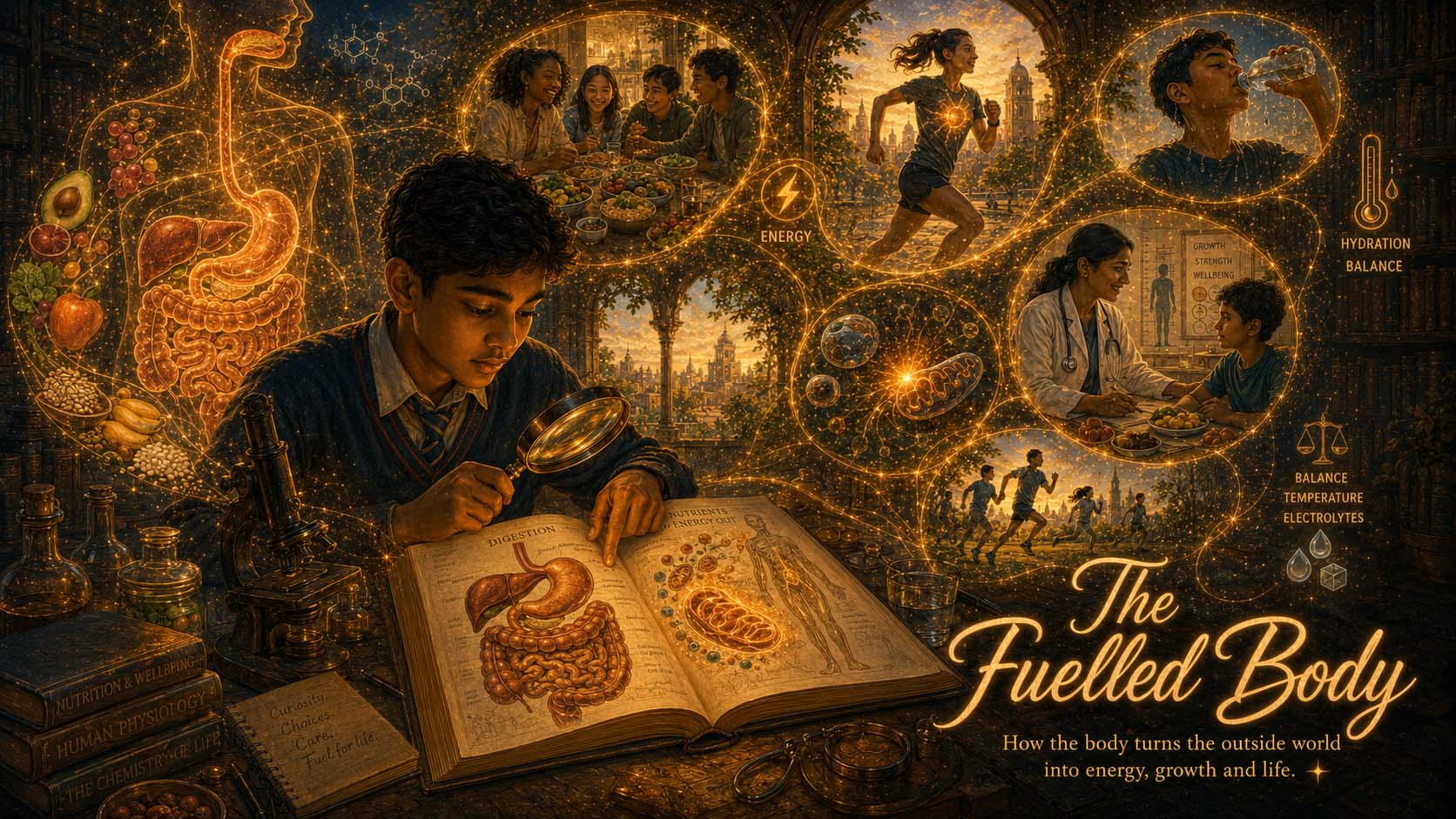
The Fuelled Body explores how the body obtains, transforms, stores and regulates the materials it needs to remain alive.
You will begin with hunger and appetite.
You will follow food after it disappears from view, discovering how it is broken down into molecules small enough to cross into the body.
You will explore how nutrients become energy, why the body stores fat and why blood sugar must be carefully controlled.
Finally, you will investigate thirst, salt and sweating—the systems that help preserve the body’s internal balance through heat, exercise, fasting and illness.
This is not simply a World about eating and drinking.
It is a story about how the body continually negotiates with its environment.
Three Paths Through the Fuelled Body
Hunger and Digestion
Hunger may feel as though it begins in the stomach.
But appetite is shaped by signals from across the body—as well as by memory, habit, smell, emotion and reward.
Why does the stomach growl? Why do some foods keep us full for longer? And what happens to food once we swallow it?
Energy and Metabolism
Food does not become energy simply because we have eaten it.
It must be broken down, absorbed, transported and transformed before cells can use it.
How does a meal become movement, thought, warmth and growth? Why does the body store energy as fat? And why must glucose remain within a narrow range?
Water, Salt and Temperature
Life depends upon balance.
Too little water, too much heat or the wrong concentration of salt can disrupt the workings of nerves, muscles and organs.
How does the brain know when we are thirsty? Why does the body need salt? And how can a layer of sweat prevent us from overheating?
Ten Questions to Follow
ELM-011
Why do we feel hungry?
Is hunger simply an empty stomach—or the brain’s interpretation of signals from the whole body?
ELM-012
Why does the stomach growl?
Are those noises really the stomach asking to be fed, or the sound of something else moving within us?
ELM-013
Why do some foods make us feel full for longer?
How do protein, fibre, fat, food volume and digestion influence when hunger returns?
ELM-014
What happens to food after we swallow it?
Follow a meal through the digestive system as it is dismantled, absorbed and transported.
ELM-015
How does food become energy?
How do nutrients eventually allow a muscle to contract, a neuron to fire and a body to grow?
ELM-016
Why does the body store fat?
Why does the body preserve energy for the future—and why is fat essential rather than merely unwanted?
ELM-017
Why does the body need to control blood sugar?
Why must glucose remain available to cells without rising or falling too far?
ELM-018
Why do we feel thirsty?
How does the brain detect that the body’s water balance is beginning to change?
ELM-019
Why do we need salt?
Why is sodium vital for nerves, muscles and fluid balance, yet potentially harmful in excess?
ELM-020
Why do we sweat?
How can water evaporating from the skin protect the body from dangerous heat?
The Body Is Always Balancing
The Fuelled Body reveals that health is not simply about having enough.
It is about having the right amount, in the right place, at the right time.
Too little glucose can starve the brain of fuel.
Too much glucose can damage tissues over time.
Too little water can reduce circulation.
Too much water can disturb the body’s chemistry.
Salt is essential, but its concentration must be controlled.
Heat is constantly produced, but it must also be released.
The body is therefore not a passive container.
It is a living system of adjustment—continually sensing, predicting and responding.
Food Is More Than Fuel
Hunger is biological, but it is also shaped by experience.
We may eat because we need energy.
We may also eat because food comforts us, connects us, reminds us of home or forms part of celebration and culture.
A change in appetite may arise from illness, medication, mood, stress, hormones or social circumstances.
Weight is similarly more complex than willpower.
Medicine must therefore ask not only:
What is the body doing?
But also:
What is happening in the life around the body?
The Fuelled Body introduces an important lesson:
Biology and lived experience are rarely separate stories.
The Calling Question
You have followed food from hunger to digestion, from digestion to energy and from energy to growth, movement and life.
What holds your attention?
Is it the chemistry of metabolism?
The hidden intelligence of appetite?
The way the body anticipates its needs?
The challenge of maintaining balance?
The connection between food, emotion, culture and health?
Or the possibility of helping when that balance is disturbed?
Do I want to understand how the body transforms the outside world into energy, growth and life?
Pause for a moment.
Notice which questions made you want to go further.
Begin World Two
Start with ELM-011: Why do we feel hungry?
The body has already begun the conversation.
Now learn how to listen.